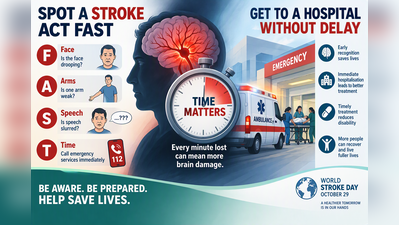
Bhubaneswar: The number of stroke cases in Odisha has more than doubled in two years from 4,252 in 2023-24 to over 9,000 in 2025-26, as recorded by the state govt, raising concern among health experts ahead of World Stroke Day on Oct 29.Doctors attributed the rise to hypertension, diabetes, obesity, smoking, sedentary lifestyle, unhealthy dietary habits and genetic factors. They stressed the need for treatment within the critical four-and-a-half-hour “golden period” to improve the chances of recovery.The neurology department of SCB Medical College and Hospital, Cuttack, treats around 400 brain stroke patients annually, witnessing a steady rise in such cases. The scenario is no different at AIIMS Bhubaneswar.Professor in the neurology department of a private medical college, Dr Lulup Kumar Sahoo, said the theme of this year’s World Stroke Day, ‘Every Minute Counts’, underlines the importance of acting quickly when stroke symptoms appear.“If a person shows signs such as facial drooping, arm weakness, speech difficulty or sudden paralysis on one side of the body, they should be taken to the nearest hospital with CT scan facilities immediately. A general medicine doctor or a neurologist can manage the patient,” he said, adding his department treats at least 200 stroke patients every month. “The number is increasing every year due to changes in food habits and lifestyle, as well as hypertension and genetic factors. Several studies indicate that Odisha is reporting more stroke cases than the national average,” he said.He further said strokes are mainly of two types — ischaemic and haemorrhagic. An ischaemic stroke occurs when a blood clot blocks a vessel supplying blood to the brain, while a haemorrhagic stroke happens when a blood vessel in the brain bursts and causes bleeding. Both can damage the brain and lead to weakness, speech difficulty or paralysis, making early treatment crucial.Senior consultant in neurology, Dr Laxmidhar Parhi, said managing high blood pressure is essential. “Awareness of risk factors can help prevent stroke. The first four and a half hours after the onset of symptoms are critical, and timely treatment during this period can significantly improve recovery,” he said.An earlier study published in The Lancet Regional Health–Southeast Asia under the National Stroke Registry Programme of the Indian Council of Medical Research said rural residents of Cuttack face a lifetime stroke risk of nearly one in seven.The study, which analysed stroke incidence and mortality across five regions of India during 2018-19, found that stroke remains a major public health concern, particularly among rural populations. It reported ischaemic stroke, caused by blockage of blood flow to the brain, as the most common type.Professor of neurology at SCB, Dr Ashok Kumar Mallick, was among the contributors to the study.