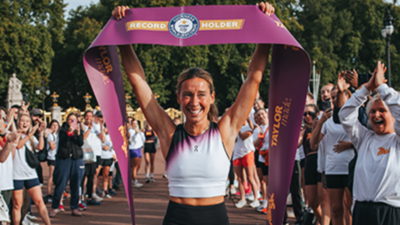
At 18, Esmée Gummer was paralysed after surgery and told she might never walk again; at 35, she has run 5,000 km in 99 days, hosted a record 76 running clubs and involved 6,684 peopleAt 18, Esmée Gummer was preparing to begin a new chapter in her life at dance college when complications during a routine surgery left her paralysed from the waist down. Just six weeks before she was due to start college, her future took an unexpected turn. Doctors warned her that she might never walk again.Nearly two decades later, Gummer, now 35, has completed a 5,000-km journey across the UK and Ireland, running for 99 consecutive days and setting a Guinness World Records title for the most running clubs hosted in different cities by an individual. She organised 76 running clubs and welcomed 6,684 participants along the way.Her journey was not simply about covering a distance or breaking a record. It was also about rediscovering movement after a life-changing setback and making exercise more welcoming for people of different ages and abilities.
From paralysis to running again
According ot the Guinness World Records, the complications that left Gummer paralysed at 18 came at a time when she was about to pursue dance at college. The possibility of never walking again was a daunting prospect for someone whose life was closely connected to movement.But she gradually learnt to walk again, returned to dancing and eventually discovered a passion for running. What followed was a journey that would take her far beyond personal recovery, turning her love for movement into an initiative designed to bring people together.Gummer’s record-breaking challenge, called The Nation’s 5K, began in Inverness, Scotland, on June 27. Over the next 99 consecutive days, she travelled between cities across the UK and Ireland, living in a campervan as she continued to run.The scale of the challenge was considerable. She covered an average of 50 km a day – more than the distance of a full marathon – while dealing with aching muscles, exhaustion and unpredictable British weather.By the time she reached London on October 3, she had spent 580 hours running. Her cumulative uphill climb had reached 62,000 metres, equivalent to ascending Mount Everest approximately seven times.
A running club where nobody had to come first
While the distance itself was remarkable, Gummer’s mission extended beyond her own physical endurance. She wanted to show that exercise could be accessible to everyone, regardless of age, ability or previous experience.Across 76 different cities, she organised free, inclusive 5-km running clubs. Participants were welcome to run, jog, walk or use a wheelchair. Experienced runners and complete beginners could take part alongside one another, without the pressure of competing for the fastest time.One detail stood out: Gummer deliberately finished last so that nobody would feel left behind.The approach shifted the focus away from speed and performance towards participation. For some, the events offered an opportunity to challenge themselves physically; for others, simply turning up and completing the distance was an achievement in itself.Each stop brought together people who might otherwise never have met. The clubs became spaces where participants could exercise, share experiences and make connections, demonstrating that a running event did not have to be about winning to be worthwhile.By the end of the challenge, 6,684 people had participated in the clubs. The initiative also raised thousands of pounds for charity, supporting spinal cord injury research, mental health initiatives and local causes.
‘This record isn’t really about me’
Gummer completed the challenge in London. Reflecting on the achievement outside Buckingham Palace, she acknowledged the kindness of the people who had supported her along the way.“This record isn’t really about me,” she said, according to Guinness World Records. “It’s what happens when people show up for each other.”The statement captures the larger idea behind The Nation’s 5K. Although Gummer’s physical endurance made the record possible, the participation of thousands of people gave the challenge its wider purpose.Her story also brings her journey full circle. At 18, she faced the possibility of losing the ability to walk; at 35, she had spent 99 days running across two countries, encouraging thousands of others to take part in an activity that can often seem intimidating to beginners.The achievement is a reminder that progress does not always follow a predictable path. For Gummer, learning to walk again eventually led to running, and running became a way to create opportunities for others.Her 5,000-km journey may have ended in London, but its impact extended beyond the finish line. In bringing together thousands of people of different abilities and experience levels, she demonstrated that the most meaningful part of a sporting achievement can sometimes be not how quickly one finishes, but how many people are encouraged to join in.