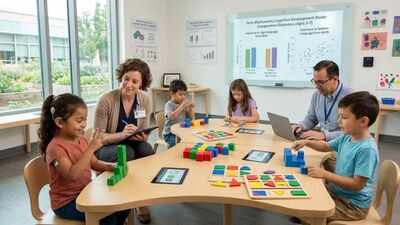
A child points to three colourful fish and is asked a simple question: how many are there? The answer may seem easy, but understanding what the number three actually represents is an important step in early mathematical development. A new study suggests that deaf children can develop this understanding at a level comparable to hearing children when they have access to language from birth. The research, published in the journal *Child Development*, highlights how early communication can shape the way children learn numbers, regardless of whether they use a spoken or signed language.Led by Marie Coppola, a professor of psychological sciences and linguistics at the University of Connecticut, the study examined 178 children between approximately three and seven years old. The findings challenge the assumption that spoken language is necessary for children to develop early maths skills.
The hidden meaning behind counting numbers
Most children learn to recite numbers before fully understanding what they mean. A child might count, “One, two, three,” while pointing at three objects. However, recognising that the final number represents the total quantity takes another step in learning. Researchers call this the cardinal principle. It means understanding that when objects are counted correctly, the last number said tells us how many objects are in the entire group.Coppola explains that children first learn to count, then begin to understand the meanings of number words, and eventually grasp this principle. As she puts it, “It’s not like there’s something special about that last one that makes it seven. No, it’s the whole set that’s seven.” This understanding typically develops between the ages of three and a half and five and a half, and it is considered an important foundation for later mathematical learning. The researchers wanted to understand whether children’s access to language influenced how they developed this skill, particularly when comparing deaf and hard-of-hearing children with hearing children.
What the researchers asked children to do
The research team assessed 178 children, including 120 deaf and hard-of-hearing children and 58 hearing children. Participants had different language experiences. Some had access to American Sign Language (ASL) from birth through signing parents; others had early exposure to spoken English, while some began accessing language later in childhood. The researchers tested how far children could count without making mistakes. They also gave them objects to count and asked them to create groups containing specific quantities. These activities helped the team assess whether children could simply recite numbers or genuinely understood what those numbers represented.The study found that hearing children who learnt spoken English from their parents from birth performed comparably to deaf children who learnt ASL from their parents from birth. “If you compare hearing kids learning spoken English from their parents at home to deaf kids learning ASL from their parents at home, those kids are indistinguishable,” Coppola said. “They have totally comparable performance.” The findings also showed that children with early access to spoken or signed language generally performed better on the number tasks than children who gained access later. The pattern remained when researchers accounted for socioeconomic status.
Why early language access makes a difference
Language helps children connect number words or signs with the quantities they represent. Without consistent access to a language they can understand, children may have fewer opportunities to build these connections during their early years. The study does not suggest that deafness itself limits a child’s ability to understand maths. Instead, the findings point towards the importance of accessible language during early development.Coppola has long advocated for greater awareness of the benefits of early language exposure for deaf and hard-of-hearing children. She also challenges the persistent belief that speech is essential for intelligence and learning. “Even though we know ASL is a natural language, there is this very, very strong idea, it’s millennia old, that speech is associated with intelligence and ability to learn,” she said. Her research adds evidence that signed and spoken languages can both support children’s understanding of numbers. However, it does not mean that every child will develop at the same pace or that language access is the only factor involved in learning.
What parents and educators can take away
The findings have important implications for families making decisions about communication and early education for deaf children. Coppola hopes the research will help parents understand that learning a sign language can support academic development rather than hold it back. Hearing parents can also learn to sign alongside their children, giving them more opportunities to communicate, learn and explore concepts together. “I want people to see that ASL is a language of academics,” Coppola said, explaining why she signs her talks when deaf people are part of the audience and tries to amplify their perspectives.The wider message is that children need early access to language they can understand. Whether that language is spoken or signed, it can help them build the foundations for learning, including the ability to count and understand quantities. For a child learning that three fish mean three fish, the lesson is about much more than numbers. It is also a reminder that accessible communication can open doors to learning from the very beginning.