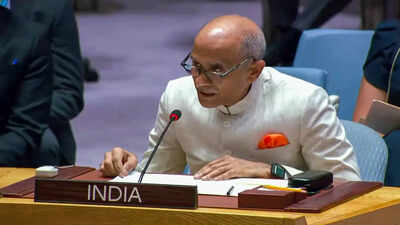
India on Thursday strongly condemned attacks against commercial vessels, advocating freedom of navigation and unimpeded maritime commerce at the United Nations.India’ permanent Representative to the United Nations, Harish Parvathaneni, stressed the need to protect seafarers in accordance with international law.Speaking at the UN Security Council’s open debate on emerging technologies and maritime security on Thursday, Parvathaneni said disruptions at critical maritime choke points could have consequences far beyond their immediate geographical locations.“Recent attacks against commercial shipping have demonstrated how disruptions at critical maritime choke points can have consequences far beyond their immediate geography,” he said, adding that such incidents threaten seafarers, disrupt supply chains and disproportionately affect developing countries through higher costs and economic uncertainty.Parvathaneni also highlighted the growing role of emerging technologies in maritime security, noting that artificial intelligence, autonomous systems, satellite-based surveillance and advanced cyber capabilities offered opportunities to strengthen security but could also create new vulnerabilities if misused.The Indian representative said AI-enabled analysis of satellite imagery, radar and vessel-tracking data could improve maritime domain awareness, help detect suspicious activities and support search and rescue operations.He cited India’s Information Fusion Centre – Indian Ocean Region, located near New Delhi, as an example of the value of cooperation and information sharing in strengthening maritime security.The representative said India’s approach was guided by the vision of Sagar (Security and Growth for All in the Region) and its broader commitment to inclusive maritime cooperation.Parvathaneni also flagged the risks arising from increasing digitalisation and automation, which expose ports, vessels, communication networks and undersea infrastructure to cyber threats.The proliferation of autonomous systems, he said, raised complex questions relating to attribution, accountability and unintended escalation. He called for appropriate safeguards, meaningful human oversight and clear responsibility in the deployment of emerging technologies.
Share your thoughts in the comments
Be respectful · TOI community guidelines
He said the UN Charter and international law, including the law of the sea as reflected in the United Nations Convention on the Law of the Sea (Unclos), provided the essential framework for state conduct.The Security Council, he added, should focus on technological developments with demonstrable implications for international peace and security, while encouraging practical cooperation, confidence-building and resilience.Parvathaneni said India had identified artificial intelligence and maritime security as important priorities for its candidature to the Security Council for 2028–2029.“Our objective is clear: technology must strengthen human security, not undermine it; it must expand opportunity, not inequality; and it must make our shared maritime commons safer, not more contested,” he said.