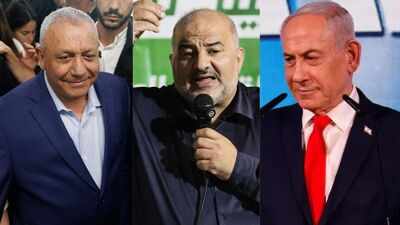
NEW DELHI: Arab parties emerge as kingmakers in Israel’s next government after Prime Minister Benjamin Netanyahu’s bloc fell short of a parliamentary majority, with their combined 19 seats potentially offering the opposition a path to power.However, disagreements within the opposition and uncertainty over cooperation with Arab factions could complicate efforts to form an alternative government.Israel’s final election results confirmed that Netanyahu’s Likud-led bloc secured 53 seats in the 120-member Knesset, while the four main opposition parties won 48. The remaining 19 seats went to Arab factions, leaving all sides short of the 61 seats required for a majority.Likud emerged as the largest party with 27 seats, while opposition leader Gadi Eisenkot’s Yashar secured 21. The Joint List won 11 seats and Mansour Abbas’s Ra’am secured eight, taking the combined strength of the Arab parties to 19.The results have put Arab parties at the centre of coalition negotiations, with their support potentially determining whether Netanyahu retains power or the opposition manages to form an alternative government.
What are Arab parties likely to do?
The two Arab political groupings have different approaches to participating in the next government, making their support far from guaranteed.Ra’am, led by Mansour Abbas, has previously participated in a governing coalition. The party joined the Bennett-Lapid government in 2021 and is seen as a potential partner in another arrangement that could keep Netanyahu out of power.The Joint List, comprising Hadash, Ta’al and Balad, has indicated that it could support an alternative government from outside the coalition rather than necessarily joining it. Its support could help an opposition-led minority government survive parliamentary votes.However, Abbas has expressed doubts about the possibility of forming a minority government under Eisenkot with outside support from Arab parties. According to Channel 12 News, as cited by The Times of Israel, he told party members that such an arrangement was unlikely or impossible.
Opposition divided over partnership with Arab parties
The opposition’s ability to secure Arab support is also complicated by differences among its own leaders.Yisrael Beytenu chairman Avigdor Lieberman, whose party won seven seats, has reportedly opposed both joining a government with Arab parties and supporting a minority administration dependent on their backing.Meanwhile, Yair Golan, chairman of The Democrats, has supported cooperation with Arab parties to form a government without Netanyahu. He met Ra’am chief Mansour Abbas on Thursday to discuss a possible political partnership.Eisenkot also met B’Yachad chairman Naftali Bennett and Golan as opposition leaders began exploring possible coalition arrangements.The political uncertainty has also prompted demonstrations outside Eisenkot’s residence in Herzliya. Protesters urged him to cooperate with Arab parties to prevent Netanyahu from returning to power, chanting, “There is no change without partnership.”Amir Badran, deputy mayor of Tel Aviv-Jaffa, was among those attending the demonstration and expressed support for a partnership between the opposition and Arab parties.
What are Netanyahu’s options?
Despite falling short of a majority, Netanyahu remains in contention to form the next government. His Likud is the largest party in the Knesset, and his bloc has 53 seats, leaving it eight short of the majority mark.Netanyahu and finance minister Bezalel Smotrich, who leads Religious Zionism, have reportedly met to coordinate their efforts following the election.The opposition could also explore a broader unity government involving Likud, Yashar, Bennett’s B’Yachad and Lieberman’s Yisrael Beytenu. Together, these parties could command 66 seats, although such an arrangement appears difficult given the opposition’s campaign pledge to remove Netanyahu from power.The final results will be submitted to President Isaac Herzog on November 4. He is expected to consult political parties before assigning a candidate the mandate to form a government. The newly elected Knesset is scheduled to be sworn in on November 10.If the government formation process fails within the stipulated timeframe, Israel could face another election.