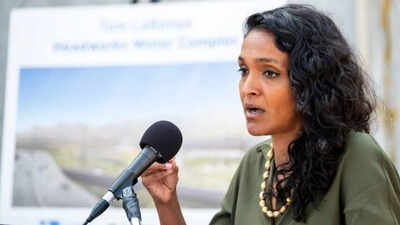
TOI Correspondent from Washington: For all the attention that the 2026 midterm elections in the US are attracting over control of the House, Senate, and governorships, a municipal contest in California with strong political and electoral ties to India is challenging the Golden State — and America’s — reputation as a bastion of capitalism.The Mayoral election in Los Angeles, whose $ 15 billion budget matches that of Costa Rica or Chhattisgarh, pits incumbent Karen Bass, 73, against Nithya Raman, 45, an India-born socialist councilwoman whose challenge has turned into one of the more intriguing political contests of the election season. Polls show the race currently tied, with Bass, a Democrat backed by the establishment, including California Governor Gavin Newsom, Kamala Harris, and Nancy Pelosi, clawing back from a ten-point deficit in September.If however Raman wins on Nov 3, LA will join New York City, now led by Zohran Mamdani, in having a mayor of Indian ancestry identified with democratic socialism. It would underscore the irony of two of America’s most economically powerful, globally influential and famously expensive cities being governed by politicians from a movement that Trump and his political allies routinely portray as an existential threat to American capitalism.Raman’s story has a typical Indian middle class template. Born in Kerala, she moved to the U.S at the age of six and grew up in Louisiana and Massachusetts, going to become an accomplished urban planner after graduating from Harvard and MIT. She moved back to India in 2009, establishing Transparent Chennai, an urban research and advocacy initiative, and worked on sanitation and water access in the city. Returning to LA in 2013, she became involved in neighborhood activism, particularly around homelessness anf affordability. She is married to Vali Chandrasekaran, a Hollywood tv screenwriter, whose credits include episodes for hit sitcoms 30 Rock and Modern Family.In 2020, Raman defeated an incumbent to become the first Indian elected to the LA City Council and went on to build a reputation for activism on affordable housing, tenant protections, and climate policy, eventually identifying herself as a Democratic Socialist. Her Mayoral campaign centers around a simple proposition: LA is a spectacularly wealthy city that is somehow lousy at providing basic services to its residents. She promises more affordable housing, better public infrastructure and a more accountable homelessness program, pointing to a nearly 50% reduction in street homelessness in her council district, even as the city’s overall numbers have increased — a jab at Bass whose term is dogged by rising living costs, infrastructure gridlock and persistent homelessness in the City of Angels.There is, incidentally, an interesting Indian historical footnote to LA’s — and for that matter California’s and America’s — flirtation with socialism. Long before Mamdani and Raman began making their mark in American municipal politics, several prominent Indian nationalists and intellectuals had encountered the country’s radical political traditions first hand.Lala Lajpat Rai spent five years in the U.S between 1914 and 1919, establishing the India Home Rule League and publishing the journal Young India in New York. The radical humanist MN Roy arrived in the US in 1916 as a global itinerant, encountered American radicals and began studying socialism, subsequently moving to Mexico City, where he founded the Communist Party of Mexico in 1919. He later played a foundational role in establishing the Communist Party of India in 1920.B.R. Ambedkar, meanwhile, studied at Columbia University in NYC, encountering some of America’s leading liberal and progressive intellectuals, including philosopher John Dewey. And Jayaprakash Narayan spent seven years in America (1922-1929), studying at Berkeley, Iowa, and Wisconsin, where he encountered Marxism and returned to India a committed socialist.All this was at a time socialism was enjoying considerable electoral popularity. In 1912, Socialist Party presidential candidate Eugene Debs won nearly a million votes, then about 6% of the national total. Socialists also held hundreds of municipal offices, including mayoralties. In fact, in the early 1950s Donald Trump’s father Fred Trump clashed with the folk singer Woody Guthrie, an avowed socialist, over racial segregation and housing discrimination in Brooklyn, causing him to write a song — a scalding takedown of a predatory landlord — titled “Old Man Trump” who stirred up racial hatred “in the bloodsport of the human heart.“The subsequent “Red Scare” and the association of socialism with communism marginalized the movement, but almost a century later “the times they are a-changing.” Of course, Mamdani and Raman represent a different generation and a more modern version of democratic socialism. Neither is proposing to abolish private property or install a Soviet-style command economy; their politics revolve around housing affordability, public services, redistribution, workers’ rights and making the wealthy contribute more towards the common good.For Trump, who has made fighting socialism a defining feature of his political identity, the prospect of New York and Los Angeles being governed by two such politicians, that too of “foreign” origin, might be particularly galling. For India, meanwhile, there is something deliciously ironic about the possibility that two of America’s most influential cities could be led by activists with Indian roots, carrying forward a political tradition that some of India’s own intellectual giants first encountered on American soil.