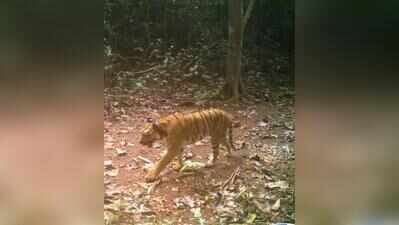
Bhubaneswar: The forest department’s wildlife wing on Monday released a fresh camera trap photograph of tigress Yamuna, offering evidence that the big cat remains healthy and is well-settled in Kuldiha wildlife sanctuary, nearly two years after being translocated from Maharashtra’s Tadoba-Andhari Tiger Reserve.The latest image, captured on Oct 11, shows the four-year-old tigress moving inside Kuldiha, reinforcing officials’ confidence that she has successfully adapted to her adopted habitat. Yamuna was brought to Similipal tiger reserve as part of India’s first inter-state tiger translocation programme and was released from an enclosure in the south division of Similipal in Nov 2024.A senior wildlife officer said the tigress continues to wear the radio collar fitted during the translocation exercise. However, the collar’s battery is nearing exhaustion, greatly limiting its ability to transmit signals. Despite this, camera-trap images have regularly confirmed her presence and good health within the sanctuary. “Since her release, Yamuna has not returned to Similipal. After being released from the enclosure, she moved to Kuldiha and has remained there,” the officer said.Kuldiha forms part of the larger Similipal biosphere landscape, although it lies outside the jurisdiction of Similipal Tiger Reserve. Forest officials said Yamuna has established a stable home range in the sanctuary and appears to be thriving in the habitat.Interestingly, despite extensive monitoring during All-India Tiger Estimation exercise conducted in Nov and Dec last year, officials found no evidence of Yamuna encountering a male tiger. Thousands of camera traps were deployed across the landscape during the survey, but none captured any interaction involving the tigress and a potential mate.Wildlife experts, however, are not concerned. Officials pointed out that male tigers from Similipal are gradually dispersing into adjoining forest areas and have frequently been sighted near Kuldiha’s borders.“The fact that she has not encountered a male so far does not mean she won’t in the future. During an estrus cycle, hormonal changes attract male tigers. As more males disperse into the landscape, the chances of Yamuna finding a mate will increase,” a wildlife officer said.Officials added that female tigers generally acclimatise to new habitats more quickly than males and expressed optimism that Yamuna will eventually pair with a suitable male, a development that could help strengthen Kuldiha’s emerging tiger population.