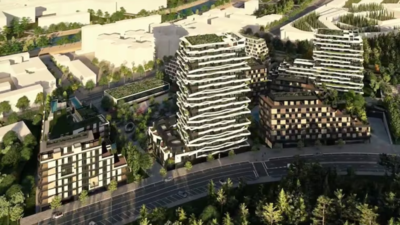
A shopping centre that once echoed with David Bowie‘s music, welcomed international rock stars and drew motorsport enthusiasts to its go-kart track is now history. Madrid’s iconic La Ermita shopping centre, which became a popular entertainment destination after opening in the 1990s, has been demolished after around 18 months of work. Its 44,349-square-metre site in the city’s Latina district is set to undergo a €77 million transformation, making way for 529 homes, two residential towers and new public spaces close to Madrid Río.The redevelopment marks a significant change for a property that was once associated with concerts, bowling, water parks and karting. According to Spanish media reports, the former complex in the Los Cármenes neighbourhood hosted the Aqualung concert venue, where artists including David Bowie and Iggy Pop performed. The shopping centre also housed a go-kart circuit associated with Spanish rally driver Carlos Sainz, alongside one of Spain’s oldest bowling alleys and what was described as the first indoor water park in Madrid.
When La Ermita was a major entertainment destination
La Ermita was developed during the 1990s, when its combination of shopping, sports and entertainment facilities made it a recognisable leisure destination in the area. One of its biggest attractions was Aqualung, a concert venue with a capacity of around 2,000 people. It hosted 715 concerts and was also the setting for eight live albums and six DVDs, according to a 2006 report by El País.The venue’s history included performances by several international musicians, with David Bowie and Iggy Pop among the names associated with the complex. Other acts mentioned in reports include Oasis, Status Quo and Duran Duran. Aqualung eventually closed on March 4, 2006, with The Magic Numbers performing on its final night. The closure was linked to renovation plans for the shopping centre.The complex also offered attractions that went beyond conventional retail. Its indoor water park, which opened in the early 1990s, was described by El País as the first of its kind in the Spanish capital. It featured a wave pool, while the wider sports and leisure complex included commercial outlets and other recreational facilities. The go-kart circuit associated with Carlos Sainz added another attraction for visitors.Over time, however, the centre lost much of its appeal. By September 2024, El País described it as a largely deteriorated complex, with only a handful of businesses and facilities, including a bowling alley, gym, Burger King and the karting attraction, still operating. Its decline became part of a wider debate about what should happen to the privately owned site.
Why the former mall is being replaced
The redevelopment has been controversial among local residents. While Madrid’s authorities have presented it as an opportunity to regenerate an underused area and increase the supply of housing, neighbourhood groups have raised concerns about the scale of the construction, traffic, pressure on public services and the possibility of gentrification.The shopping centre’s owners acquired the property in 2012 for around €16 million, according to El País. The subsequent redevelopment proposal went through several planning stages and faced opposition from residents and local groups. In 2024, the debate intensified as neighbourhood associations challenged the plans, arguing that the project could prioritise private interests over the needs of existing residents.Madrid City Council gave initial approval to the urbanisation project in May 2026. Its announcement described a development covering 44,349 square metres and proposed 530 homes, including 159 protected units. More recent reports following the completion of demolition have cited 529 homes, comprising 370 market-rate properties and 159 protected homes.
Two residential towers, green spaces and public facilities
The latest reported €77 million plan includes two residential towers of 21 and 17 floors near Calle Sepúlveda. The development is expected to combine private housing with protected homes, commercial spaces and public facilities. The project also includes a neighbourhood market of around 1,500 square metres, shops at the ground level, an indoor swimming pool, a gym and parking facilities.A major feature of the redevelopment is a 60-metre-wide green corridor intended to connect the parks of La Ermita del Santo and Caramuel with Madrid Río. The plan also includes around 11,000 square metres of landscaped public spaces and an additional 5,600 square metres of green areas. Madrid City Council has announced plans to plant 297 new trees as part of the development.The proposal also allocates 18,879 square metres of building capacity for public facilities. Streets including San Rufo and San Conrado are expected to become pedestrian-friendly routes, improving access between the residential development, nearby parks and Madrid Río.According to the latest reports, the demolition has also preserved three electrical transformation centres that previously supplied the shopping complex. These are expected to serve the new residential development.The project is being led by the Venezuelan Finol family, which owns 80% of the land, and the Saf Son group, which holds the remaining 20% and is involved in managing the development. Real estate company Dazia Capital has also acquired two plots measuring 18,803 square metres for €50 million to develop part of the housing.