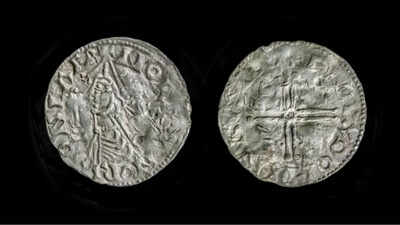
A rare coin minted during the reign of Norway’s King Olaf Haraldsson around 1025 has been discovered in a Viking hoard in Norway. The coin was found among thousands of objects recovered from the Morstad Hoard, discovered by two metal detectorists in April. It is only the second coin of this type to have been found in Norway, with the previous discovery dating back to 1924.The coin was identified by archaeologist Anne Skogsfjord while she was examining and cataloguing the coins from the hoard, according to Jerusalem Post. The discovery was made after the object was initially placed in a group of coins believed to have been issued by an English king. Its inscription helped establish that it was actually minted during Olaf Haraldsson’s reign.Olaf Haraldsson, also known as Saint Olaf or Olaf the Holy, ruled Norway from 1015 to 1028. He was later given the title of “Eternal/Perpetual King of Norway” and was declared a saint in 1030, a year after his death.His reign was an important period in the spread of Christianity in Scandinavia. The newly identified coin also offers evidence of how he used money and royal symbols to establish his position as a Christian ruler.
How the rare coin was identified
The Morstad Hoard was discovered in April by metal detectorists Vegard Sorlie and Rune Sætre in Rena, Norway. It is described as the largest Viking Age coin hoard ever found in the country.While cataloguing the collection, Skogsfjord initially classified the coin as Anglo-Saxon. It was placed with coins issued under the rule of Æthelred II, who ruled England in two periods, from 978 to 1013 and again from 1014 until his death in 1016.However, something about the inscription caught her attention. She noticed that the lettering appeared to belong to a slightly later period than the other coins in that group.“I could see that it read ONLAF R+ NORMANORV. Could this really be a coin of Olaf Haraldsson that I was holding? And it was!” said Skogsfjord. “It was a very special moment. I realised that we had found a national treasure.”The inscription identifies Olaf as the King of the Norwegians. The coin carries a portrait of the king on one side. He is shown facing left and wearing a conical battle helmet.The other side features a cross placed on three steps. The design was inspired by Byzantine coinage. According to the researchers, its appearance was modelled on Anglo-Saxon pennies minted during the reign of Cnut the Great, around 1024 to 1030.The coin is believed to have been produced between 1024 and 1028, towards the end of the Viking Age.
Coinage used to promote Christianity
The design of the coin offers clues about how Olaf presented himself as a ruler. It carries his portrait, his royal title and Christian symbols on both sides.Numismatics Professor Svein H. Gullbekk said the coin was an important discovery for understanding Norway’s early monetary history.“For those of us interested in Norway’s earliest monetary history, it hardly gets any better than this,” he said. “Here we have a coin bearing the king’s portrait and a cross, with another cross on the reverse. It is a Christianisation coin on a grand scale.”Gullbekk also said Olaf used coinage to establish his authority and connect his rule with the Christian faith. “We can see how King Olaf used coinage to legitimise the new faith and to establish himself as a Christian king of European standing. This is branding,” he said.The discovery is particularly significant because very few coins from Olaf’s reign have survived. Fewer than 20 are known to exist today, and most have been discovered outside Norway.Among these, only four coins of the same type as the Morstad find have been identified. Before this discovery, just one such coin had been found in Norway. It was recovered in 1924 during restoration work at church ruins in Stein. This makes the latest discovery the first of its kind in Norway in more than a century.
Cuts on the coin show it was used in transactions
Researchers have also found marks on the coin that provide information about how it was used after it was minted. Both sides have small cuts that appear to have been made with a knife. These marks are believed to have been used to check the silver content of the coin during payments and other transactions.Associate Professor Florent Audy explained that such cuts were a way of testing the metal before accepting it as payment. “This was a way of testing the silver content during payments and other transactions,” he said.Based on these marks, researchers believe the coin changed hands several times before it became part of the Morstad Hoard.Audy said it may have circulated for around 20 to 25 years between the time it was made and the time it was deposited in the hoard.“On that basis, we may assume that the coin changed hands several times during the approximately 20 to 25 years between its production and its deposition in the Morstad Hoard,” he said. “That is yet another fascinating chapter in the coin’s history.”
Rare discovery to go on public display
The discovery has been welcomed by Norway’s cultural heritage authorities. Hanna Geiran, Director General of Norway’s Cultural Heritage Directorate, said the hoard continued to reveal new finds.“When you think this Viking treasure cannot become any more exciting, new surprises emerge,” she said. “This St. Olav coin is yet another reminder of how extraordinary this find is.”She added that the coin was more than a rare archaeological object. It provided evidence from a period when Norway’s kingdom was taking shape and Christianity was spreading across the country. “The coin is not only a rare object, but also tangible testimony from a time when the foundations of the Norwegian kingdom and the Christianisation of the country were laid,” Geiran said.The coin will be displayed as part of an upcoming exhibition on the Morstad Hoard at Norway’s Historical Museum. The exhibition is scheduled to open on November 20.