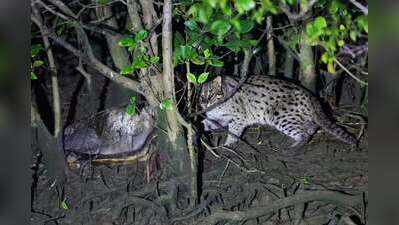
Kendrapada: Wildlife Institute of India researchers have documented fishing cats scavenging on Olive Ridley sea turtle carcasses in Bhitarkanika, providing rare direct evidence of the threatened wild cat’s scavenging behaviour.The researchers recorded two instances of fishing cats (Prionailurus viverrinus) feeding on dead Olive Ridley turtles (Lepidochelys olivacea). The study was recently published in the summer 2026 issue of CATnews, the journal of IUCN/SSC Cat Specialist Group.The first observation was made on Feb 29, 2024, during a camera-trap survey in Rajnagar range of Bhitarkanika National Park. Researchers found an Olive Ridley carcass on a mudflat, with several pugmarks around it and pieces of flesh dragged away.The pugmarks were identified as those of a fishing cat based on their size and measurements, researcher Govindan Veeraswami Gopi said. The other researchers were Bijoy Kumar Das, Ajinkya Bankar and CS Ashik.A second incident was documented on the night of Jan 28, 2025, when a fishing cat was photographed scavenging on another Olive Ridley carcass. Researchers said this confirmed that fishing cats in the region use dead marine animals as food.Bhitarkanika National Park, in the deltaic region of Brahmani and Baitarani rivers in Kendrapada district, is an important mangrove ecosystem. The area, including Gahirmatha coast, is a crucial feeding and breeding ground for vulnerable Olive Ridley turtles.Fishing cats occur mainly in mangroves and floodplains of eastern and south-eastern Asia. In India, they are largely associated with coastal mangrove habitats. Their diet includes fish, crabs, molluscs, amphibians, reptiles and small mammals, but direct evidence of scavenging has been limited.Researchers said turtle carcasses are frequently washed ashore or are trapped in mangrove vegetation and on mudflats during low tide. Olive Ridley deaths in the region are largely attributed to fishing activities, particularly trawling, in which turtles are accidentally caught in nets and drown.The researchers said turtle carcasses, along with those of saltwater crocodiles and dolphins, may provide food for fishing cats and other opportunistic scavengers. The observations could improve understanding of fishing cats’ feeding ecology and behavioural adaptability, as scat analysis cannot conclusively establish whether prey was hunted or scavenged.