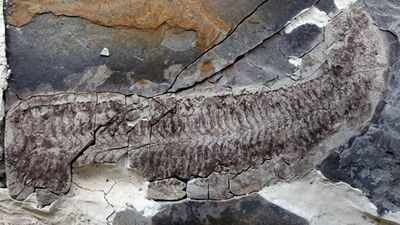
A marine creature that lived 444 million years ago has become the subject of a remarkable fossil study after scientists discovered that its internal structures survived while much of its outer body disappeared. The fossil, identified as a new species called Keurbos susanae, preserves muscles, tendons, connective structures and digestive remains in exceptional detail, despite lacking its head, legs and most of its hard outer covering. After 25 years of research, University of Leicester palaeontologist Sarah Gabbott formally named the species after her mother, Sue, recognising the encouragement she received to pursue a career in fossil research.
The 444-million-year-old fossil preserved its inside organs
According to the University of Leicester, the fossil presents an unusual reversal of the way many ancient animals are preserved. Most arthropod fossils show their hard external features, including shells and limbs, because these structures generally survive decay more easily than soft tissues. Keurbos susanae instead retains an extraordinary record of its internal anatomy, while much of its external body is missing.The research, published in Papers in Palaeontology on 26 March 2025, describes the species as an exceptionally preserved marine arthropod. In a scientific paper, the internal anatomy of the creature is described as preserved in three dimensions, enabling scientists to view structures seldom observed in fossils from the same period.The fossil’s unusual preservation is particularly important because muscles and other soft tissues normally disappear soon after an animal dies. Their survival offers researchers an opportunity to study aspects of ancient animal anatomy that are often absent from the fossil record.
What was the creature like when it lived
The scientific paper provides a more detailed picture of the animal’s body. Its trunk contained 46 segments arranged in a repeating pattern, gradually becoming narrower towards the rear. The researchers identified structures associated with its internal supporting framework, including connections between body segments and features linked to its muscles.The main specimen measures approximately 43 centimetres in length, making it a substantial animal for the fossil deposit in which it was discovered. Its segmented body and other anatomical characteristics helped researchers identify it as a member of the arthropod group.Arthropods include familiar modern animals such as crabs, lobsters, spiders, insects and millipedes. Their bodies commonly feature repeated sections and a hard external covering. However, the precise evolutionary position of Keurbos susanae remains uncertain because important anatomical features are missing or difficult to interpret.The research notes that the fossil’s unusual preservation makes comparisons with other ancient arthropods particularly challenging. Although researchers can confidently recognise it as an arthropod, they cannot establish exactly which evolutionary branch it belongs to.
Where was the unique marine fossil discovered
The specimens came from the Soom Shale, a fossil-rich geological formation in South Africa’s Western Cape Province. According to the University of Leicester, the site lies approximately 250 kilometres north of Cape Town, in an area where ancient marine sediments preserve evidence of life from the end of the Ordovician Period.The research paper places the fossils within the Late Ordovician, a period that ended around 444 million years ago. This was a particularly difficult time in Earth’s history, when extensive glaciation contributed to one of the planet’s major extinction events.The University of Leicester says the marine basin this animal lived in seems to have provided some protection from the worst effects of this environmental upheaval. Researchers found evidence of life in an unusual setting: a community of marine organisms that survived there.The Soom Shale is also known for its distinctive preservation conditions. Its sediments formed in an environment with extremely low oxygen levels and, at times, highly toxic hydrogen sulphide in the water. The scientific paper identifies these conditions as important characteristics of the deposit, although the precise chemical processes responsible for preserving Keurbos susanae remain complex.
The fossil lost its outer body
The preservation of Keurbos susanae appears to have followed an unusual process that affected its internal and external structures differently.The research paper describes the fossil as displaying a reversed pattern of preservation. Structures that projected beyond the body, including certain specialised plates, retained some details, while much of the external covering and appendages were poorly preserved or missing.Inside the body, however, mineral replacement captured muscles and other delicate anatomical structures in three dimensions. This gave researchers access to details that are rarely available in fossils of ancient arthropods.The authors explain that the fossil’s internal supporting structures and muscle anatomy provide a detailed view of the animal’s body organisation. Such preservation is rare because these tissues normally decay before they can become part of the fossil record.
How did a 25-year study lead to the name Sue
Professor Sarah Gabbott, from the University of Leicester’s School of Geography, Geology and the Environment, spent 25 years examining the fossil before formally describing the species.The university’s announcement explains that Gabbott discovered the material early in her academic career. The fossil proved difficult to interpret, and she continued hoping that additional specimens might reveal more of its anatomy, particularly its head and limbs.The scientific paper ultimately describes two specimens, collected during fieldwork spanning approximately 20 years. However, further discoveries have become increasingly unlikely because quarrying activity has made the principal collecting site difficult to access.Gabbott named the species Keurbos susanae in honour of her mother, Susan Gabbott, affectionately known as Sue. The scientific paper records the name as a tribute to her, while the University of Leicester announcement explains the personal reason behind the decision.Her mother had encouraged her to pursue a career that made her happy, regardless of what that career might be. For Gabbott, that meant studying rocks, discovering fossils and investigating how ancient organisms lived and evolved.The naming also followed a humorous family exchange. According to the university, Sue had recently encouraged her daughter to complete the naming before she herself became fossilised.