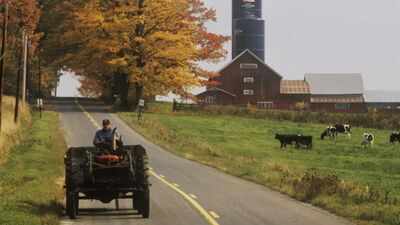
Decades of farming and a boundary fence that has stood since 1965 have helped a Utah family keep its legal rights to a disputed piece of farmland. A state appeals court has ruled in the family’s favour after a neighbouring landowner challenged the property boundary. The Utah Court of Appeals issued its decision on 5 November 2026, upholding a trial court ruling in favour of the Christiansen Family Trust. The court rejected a challenge brought by a company that owns the neighbouring property. The decision in Christiansen Family Trust v. Haas Land & Livestock (Case No. 20251107-CA) settles a long-running property dispute in Utah. It confirms that when neighbouring landowners accept and use a physical fence as their boundary for many years, that boundary can take legal priority over a newer land survey. Writing for the unanimous appeals panel, Judge Ryan M. Harris found that the trial court correctly applied Utah’s legal rule known as boundary by acquiescence. This rule protects property boundaries that neighbours have accepted over a long period. Judges John D. Luthy and Amy J. Oliver agreed with the decision.
Boundary survey triggers conflict over farm land
The Christiansen family has owned and actively farmed its rural Utah property for more than 70 years. Farming activities have continued across several generations. For nearly six decades, a fence built in 1965 marked the boundary between the Christiansen family’s farm and the neighbouring property. Both the Christiansen family and previous owners of the adjoining land treated the fence as the actual property line. Each side continued farming, grazing animals and maintaining its own land without any disagreement over the boundary. The peaceful arrangement changed after Haas Land & Livestock bought the neighbouring property in 2021. After purchasing the land, Haas Land & Livestock hired a professional surveyor to identify its exact property boundaries. The survey found that the legal boundary listed in the property deed did not match the location of the old fence built in 1965. According to the survey markers, a narrow strip of land that the Christiansen family had occupied and farmed was actually included in the legal description of the neighbouring property. Based on these findings, Haas Land & Livestock claimed ownership of the disputed strip and tried to take control of it. This led to a legal battle over who had the rightful ownership of the land.
Trial court applies doctrine of boundary by acquiescence
The Christiansen Family Trust filed a lawsuit in state district court. It argued that it had legal ownership of the disputed land under Utah’s long-standing rule known as boundary by acquiescence.Under Utah property law, a landowner may gain permanent legal ownership of land beyond the boundaries written in their deed if four specific conditions are met:
- There must be a visible marker, such as a fence, wall or monument, showing where the boundary is located.
- The person claiming the land must use and occupy their property up to that visible boundary in a way that clearly shows they are using the land.
- The neighbouring landowners must both treat and accept the visible marker as the actual property boundary.
- Both sides must continue accepting and following that boundary without interruption for at least 20 years.
During the trial, the Christiansen family presented evidence showing that the fence had remained in place since 1965. They also showed that both sides had treated it as the dividing line for much longer than the required 20-year period. Haas Land & Livestock challenged the trust’s ownership claim and tried to present video evidence during the court proceedings. However, the trial judge refused to admit the footage and ruled in favour of the Christiansen Family Trust. The judge found that clear and convincing evidence proved all the legal requirements for boundary by acquiescence had been met. Haas Land & Livestock then appealed to the Utah Court of Appeals. The company argued that the trial court’s findings were not supported by enough evidence. It also claimed that refusing to accept the video footage was a serious legal error that justified overturning the decision.
Appellate court affirms historical boundary line
The Utah Court of Appeals rejected all the company’s arguments. It found that the trial court had acted correctly in awarding the disputed strip of land to the Christiansen family. Judge Ryan M. Harris wrote that the trial court’s findings were supported by the evidence presented during the case. The appeals panel confirmed that the fence had existed since 1965 and that previous owners on both sides had accepted it as the property boundary for many years. This was enough to establish legal ownership under Utah law. “The court ruled that the trial court’s findings were supported by sufficient evidence and that the exclusion of the video evidence was not an abuse of discretion,” the appellate panel noted in its ruling, as reported by legal news service LAWS.com. The court also explained that Utah law does not require neighbours to sign a written agreement to establish a boundary through long-term acceptance. Instead, years of accepting, recognising and following a physical fence line can be enough to establish legal ownership over time. The judges also found that the trial court had the legal authority to reject the video footage submitted by the defendant. Decisions about which evidence can be used during a trial are generally left to the trial judge’s judgment, and the court found no reason to overturn that decision.
Broader implications for Utah property owners
The appeals court’s decision offers important guidance to property owners, farmers and real estate developers across Utah. It explains how courts may handle disputes involving old fence lines and newer land surveys. Legal analysts at legal publisher LAWS.com noted that the ruling highlights how courts give significant weight to the way land has actually been used over many years, especially when a long-established boundary is challenged by a newer technical survey. By ruling that 56 years of continuous and undisputed use of the fence line took priority over a survey conducted in 2021, the Utah Court of Appeals reinforced an important point for property buyers. People who purchase older rural properties may have to respect existing, visible boundaries that have been accepted and used by neighbouring landowners over a long period. The ruling leaves the Christiansen Family Trust with full legal ownership and control of the disputed strip, protecting the family’s farm boundaries as they have stood since 1965.