The Donald Trump administration wants India to buy more crude oil from Venezuela. US Secretary of State Marco Rubio’s recent visit to India to discuss the possibilities with Reliance clearly shows America’s push to increase the market for Venezuelan supplies while encouraging India to diversify away from Russian oil.Russia, however, remains India’s biggest crude oil supplier, having gained a substantial share of the country’s imports after Indian refiners stepped up purchases of discounted Russian barrels. The US has repeatedly pressed New Delhi to reduce its reliance on Russian energy, making India’s oil sourcing an important issue in bilateral trade and diplomatic negotiations.India’s attraction for the US lies in its sophisticated refining capacity. Reliance’s Jamnagar complex can process heavy Venezuelan grades that many refineries cannot easily handle.Rubio has called India a refining superpower. Expanding purchases could give Venezuelan oil a larger market while offering India another source of crude.However, replacing Russian supplies on a significant scale is not straightforward: refinery compatibility, prices, shipping costs and commercial viability will influence whether Indian refiners buy more Venezuelan oil. How much Venezuelan crude can India realistically buy?The difficulty with Venezuelan oilThe biggest problem is that Venezuelan crude oil is not easy to refine.Analysts note that the first problem is its viscosity: Venezuela’s extra-heavy crude needs to be diluted with naphtha or condensate just to move it through pipelines and export it.Then comes the high sulphur content and large residue yield, which require sophisticated refining equipment to turn the oil into valuable fuels.“This is crude that suits complex refineries, but not every refinery can handle it economically,” Natalia Katona, Commodity analyst tells TOI.Quality consistency is another concern, she notes.
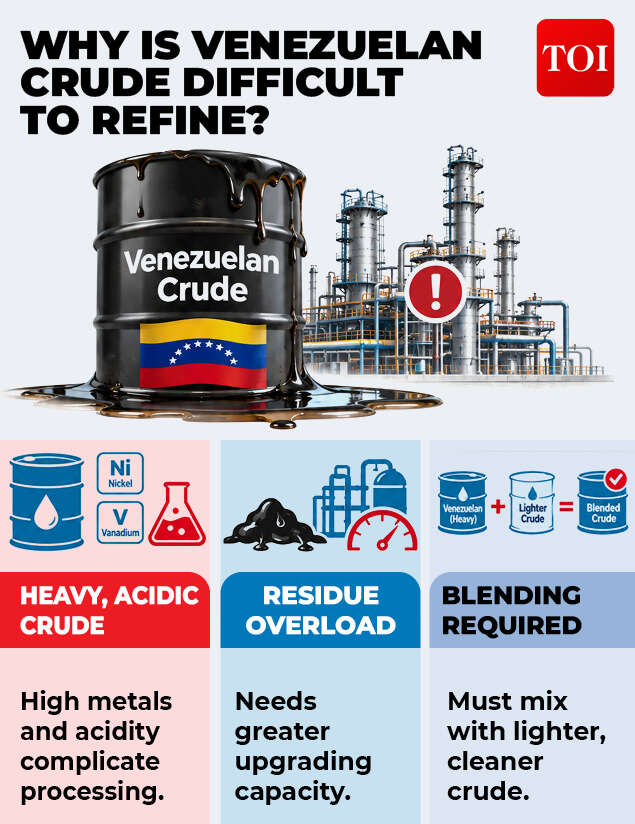
Why is Venezuelan crude difficult to refine?
The crude is high in metals such as vanadium and nickel and in acidity, which poison catalysts and corrode equipment.Naveen Das, Senior Crude Oil Analyst at Kpler says that more than half of each barrel is residue, the thick bottom fraction that must be cracked or coked to make diesel and gasoline.“Only complex refineries with cokers, hydrocrackers and ample hydrogen can earn a margin on it,” he tells TOI.Variations between cargoes, including water content, can make handling and processing more difficult. In some cargoes water content may reach 5%, which adds another operational challenge: buyers need both the equipment and the experience to manage those cargoes.How much can India really buy?According to Kpler data, India imported 4.71 million barrels per day of crude in August and 5.33 million barrels per day in September. Venezuela’s share was 7.4% at the August peak, 3.7% in September and 5.7% in October.“At 450-500 thousand barrels per day on an import base of about 5.2-5.5 million barrels per day, a realistic share is 6-9%. That would match or modestly exceed the 6.7% share recorded in FY18. A share near 10% would need more than 500 thousand barrels per day, which Venezuela’s current export base cannot supply without displacing most non-Indian buyers,” Naveen Das tells TOI.Praveen Rai, Director at Grant Thornton Bharat estimates that India can realistically absorb around 400,000–550,000 barrels per day of Venezuelan crude on a sustained basis, with short-term volumes potentially approaching 600,000 bpd under favourable conditions.“Reliance Industries’ Jamnagar complex would remain the principal buyer given its ability to process heavy-sour crude at scale. India has already demonstrated significant absorption capacity, with Venezuelan imports reaching around 444,000 bpd in August 2026,” he tells TOI.Natalia Katona points to another limitation: there will be competition from Gulf countries.“Reliance would do most of the heavy lifting, with IOC another potential buyer, because processing large volumes requires the ability to manage both the residue yield and sulphur. Jamnagar could substitute some Basrah Heavy by Venezuelan crude, but Iraq is much closer. If Iraqi barrels are available at competitive delivered prices, Venezuela has a harder case to make for Indian refiners,” Katona tells TOI.The biggest competitive obstacle is the US Gulf Coast. Its refineries are well suited to Venezuelan crude and much closer to the loading ports.However, the constraint is not simply India’s refining capacity.Venezuela’s production and export availability, shipping economics, sanctions, and the discount of Venezuelan Merey relative to Russian Urals and competing Middle Eastern grades will ultimately determine flows.“Around 500,000 bpd represents a reasonable sustainable level for India, while 550,000–600,000 bpd is achievable during favourable market conditions. Sustaining volumes materially above that level would require higher Venezuelan production and broader participation from Indian refiners beyond Reliance,” Rai says.In this case a natural question would be “can Venezuela simply produce more crude to satisfy both the US and Asian demand”?“I would be cautious about assuming production can quickly reach 2 million b/d (as some market analytics assume). In my view, reaching 1.5 million b/d by 2030 would already be good news,” she says.Does it make economic sense?According to experts, the major question is how much discount as compared to Urals will be available to Indian refineries for processing this crude economically.As Pankaj Srivastava, Senior Vice President, Commodity Market – Oil at Rystad Energy points out: Economics is based upon the configuration and complexity of the refineries and how refineries blend this crude and utilize higher production of coke.In addition to that, how much comparable crude is with Russian Urals as freight, insurance and other changes would play a role in the landed cost of the crude.Also, Indian Refineries are operating at 105-110% utilization rate. Hence, higher portions of Venezuelan crude can hamper the refinery runs.Let’s break this down further:Naveen Das of Kpler is of the view that the oil makes sense for complex refiners, but the margin is narrower than it was.It takes about 40 days via the Cape, and higher tanker rates remain a major risk to long-distance Venezuelan shipments.“The September dip is consistent with that sensitivity. Where the coker margin on the residue plus the discount exceeds freight and the distillate yield penalty, as at Jamnagar, the barrel clears; for simple refiners it does not,” he tells TOI.On the other hand, risks of Russian crude becoming costlier and carrying sanctions risk do improve Venezuela’s relative case.Praveen Rai shares some important insights:Indian customs data for August 2026 show Venezuelan crude, mainly imported by Reliance Industries, landed at 66 dollars per barrel, a 24 dollar per barrel discount to the Indian Crude Basket (ICB) on a delivered basis, compared with 88 dollars for Russian and 93 dollars for Iraqi and Arab Light grades.The headline discount can be eroded by freight since Venezuela is roughly twice as far as Russia and about five times as far as the Middle East!“Industry estimates suggest a discount of about $10-14 per barrel to Brent is needed to offset freight, insurance, and higher processing costs,” he tells TOI.“For complex private refiners, value comes from deep conversion as much as from cheaper feedstock. With most barrels allocated to US refiners and Reliance, and sales governed by US licences and Treasury-controlled accounts, refiners should treat Venezuelan crude as an opportunistic margin boost rather than guaranteed supply,” he cautions.Natalia Katona believes that while it may make some economic sense to buy crude from Venezuela, the freight bill consumes most of the headline discount!Current assessments put Merey at around $36/bbl below ICE Brent on an FOB basis, with $32–34/bbl for VLCC freight to India. That leaves only $2-4/bbl of the discount before insurance, handling and the additional processing costs, she tells TOI.“For such a long voyage, VLCCs provide the necessary scale, as smaller tankers generally make the economics harder. By contrast, Aframax freight from Venezuela to the US Gulf Coast is assessed at around $9-10/bbl. Those shorter voyages can also allow direct delivery and avoid some of the ship-to-ship transfers that larger vessels destined to far away freight require,” she adds.The bottom lineThe clearest case for significantly more Indian buying would be another deterioration in Middle Eastern supply, leaving fewer alternative heavy grades available. Even then, Indian refiners would have to bid competitively against US buyers.Natalia Katona’s view is that this diplomatic significance is larger than the likely increase in physical volumes. This way, Venezuelan oil will remain a relatively small part of India’s diversification strategy.“In my view, neither India nor the US has much appetite for a substantial increase in actual shipments to Indian refiners,” she concludes.India may have stepped up crude oil purchases from Venezuela as part of its diversification strategy and the US may be actively pushing for India to buy it, but ultimately refining constraints, competition from America for the same barrels, Venezuela production constraints will be big factors that will weigh.For now, Russia is likely to continue being the single largest supplier and as supplies from the Middle East normalise, Venezuelan crude may find its place among the top suppliers, but it is unlikely to go beyond single to early double digits in terms of share. Russia by contrast makes up over 35% of India’s crude oil imports: the difference is too stark to miss!