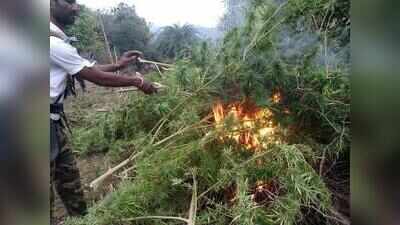
Bhubaneswar: Central paramilitary forces stationed in Odisha’s former Maoist strongholds may soon play a new role in the state’s war against narcotics. The CRPF and BSF personnel deployed in remote forested regions could be tasked with identifying and tracing illegal ganja cultivation sites, officials said.The proposal was discussed at a high-level meeting convened by the Narcotics Control Bureau (NCB) in Bhubaneswar on Wednesday. The meeting brought together drug law enforcement wings and other agencies such as NCB, Odisha Anti-Narcotics Task Force (ANTF), excise department, Enforcement Directorate (ED), customs, Directorate of Revenue Intelligence (DRI), Income Tax Department, CRPF and BSF to strengthen coordinated action against drug trafficking and emerging narcotics threats.Though anti-Naxal operations have wound down after Odisha achieved the Maoist-free tag on March 31, central forces continue to maintain a presence in vulnerable areas to prevent any resurgence of extremist activities.According to police sources, NCB has proposed that ANTF develop a specialised training module for CRPF and BSF personnel to help agencies detect signs of illicit cannabis cultivation in dense forest regions.“Illegal ganja cultivation is often concentrated in inaccessible and heavily forested pockets that were once Maoist bastions. Since Central forces continue area-domination exercises in these regions, they are uniquely positioned to identify such plantations. ANTF is fine-tuning a training programme for them to support Odisha’s goal of achieving zero ganja cultivation,” a senior police officer told TOI.The meeting also focused on targeting the financial networks behind the drug trade. NCB proposed that ED and Income Tax Department intensify financial investigations in major narcotics cases, particularly those involving traffickers who have amassed substantial assets through the proceeds of ganja cultivation and smuggling.Officials further proposed a dedicated financial investigation training programme for officers engaged in drug law enforcement. The need for specialised training for railway personnel was also highlighted to help them detect evolving methods used by traffickers to transport narcotics across states.“Drug trafficking networks are becoming increasingly sophisticated. Effective intelligence-sharing, financial investigations and multi-agency coordination are critical to dismantling not just cultivation networks but also the larger criminal ecosystem that sustains them,” another officer said.Detailed deliberations were held on enhancing intelligence-sharing mechanisms, strengthening financial probes and ensuring coordinated enforcement among agencies.