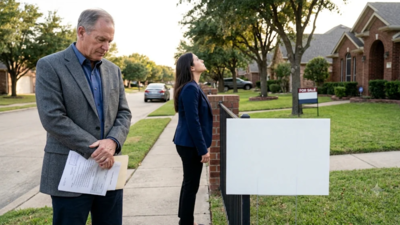
A Texas businessman who claimed he paid for a property that later passed to his deceased business partner’s children has lost his ownership challenge in an appeals court. This was despite presenting evidence of a $287,000 bank transfer that he said was used to buy the property. The Fifth Court of Appeals of Texas at Dallas upheld a lower court’s decision. It found that Kyle Harmon and his co-appellant, Gina Maria Ottavio, had failed to prove that a serious legal error was made in the probate orders. Those orders included a residential property in Plano, Texas, as part of the estate of Karrie Ellen Peterson.Harmon testified that while working overseas in 2015, he asked Peterson, his business partner in Hair Color Studios.com, LLC, to help him purchase the property. However, the warranty deed dated June 2015 named a different company, H.C.S LLC, as the property buyer. The deed was never officially recorded in the county’s property records, although a copy was given to the local appraisal district. In August 2021, Karrie Peterson died without leaving a will. After her death, a corrected document was filed in August 2022. It changed the name of the buyer on the 2015 deed from H.C.S LLC to Hair Color Studios.com, LLC. At the same time, Peterson’s children, Hunter Scott Brasher and Sarah Nichols, were recognised as her legal heirs and appointed as co-independent administrators of her estate.
Failure to prove a resulting trust claim
The case, which was reported on the legal website Justia, focused on whether the $287,000 Harmon transferred shortly after the property purchase created what is known as a “resulting trust”. This is a legal arrangement in which one person holds property for another because that other person provided the money used to buy it. In its written opinion, the Court of Appeals explained that proving this type of trust requires strong evidence. The judges found that Harmon’s evidence was not enough to meet this legal standard.According to the official court decision, the “only evidence of Harmon’s payment of the purchase price is his own testimony.” Although the businessman referred to bank records to support his claim, the court explained that “that exhibit shows only that Harmon transferred approximately $287,000 to an unidentified money-market account a week after the deed to Hair Color Studios.com LLC.” The judges also pointed out that the records “does not establish to whom Harmon sent the money, for what purpose he did so, or that Peterson received, and used, Harmon’s money to buy the Property.” The court explained that the trial judge was responsible for deciding whether witnesses were believable. The judge could have accepted all of Harmon’s testimony, rejected it entirely or decided that his statements alone were not enough to meet the high legal standard required to prove a resulting trust.
Disputed deeds and legal authority
The ownership dispute also involved different property deeds and business entities. A 2019 deed appeared to transfer the property from H.C.S. LLC to Peterson personally. Harmon argued that this transfer was not authorised because Peterson did not have the legal power to act on behalf of the company. However, the Court of Appeals pointed out that “the only testimony of Peterson’s purported lack of authority is Harmon’s testimony, which... the trial court was free to disregard or credit but find to be insufficient.” The appeals court also noted that the case records did not clearly explain the exact ownership and management structure of the business. This left open the possibility that Peterson had the authority to make the transfer because she was a majority owner of the company named on the deed. “As the proponents of the bill-of-review, Appellants bore the burden to conclusively prove Peterson’s lack of authority to enter into the 2019 transaction,” the court ruled. “Because they did not do so, they failed to establish that the 2019 deed was invalid.”
Finality in probate judgments
Harmon and Ottavio had filed what is known as a “statutory bill of review” to challenge an earlier probate court decision that awarded the property to Peterson’s children. This type of legal challenge is limited and examined very carefully. Courts generally want to ensure that final judgments remain settled. The appeals court explained that to receive a new review of a probate court order or judgment, “a party must specifically allege and prove substantial error by the trial court.” The person making the challenge must prove this at trial using a preponderance of the evidence. This means showing that their version of events is more likely to be true than not. The Court of Appeals concluded that the trial judge had not abused their discretion by finding that Harmon and Ottavio failed to meet the high legal standard needed to show a serious error in the final probate decision. The judges concluded that “undisputed evidence and conclusive evidence are not the same.” They rejected the businessman’s only appeal argument. As a result, the lower court’s decision remains in place, and the Plano property will continue to be treated as part of the estate of the late Karrie Peterson.