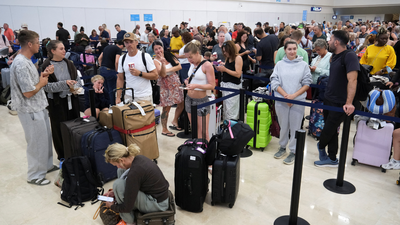
A communication glitch in the network connecting US air traffic control centres brought flights nationwide to a standstill for more than four hours on Friday. Although the grounding order was lifted late in the day, airlines still need a few days to get back on track, with several flights having been diverted during the disruption.What made the disruption particularly significant was that it was not confined to one airport or a single flight route. The trouble lay in the communication network linking regional air traffic control centres, allowing a problem at one end to ripple across the country.Michael McCormick, a former airspace manager with the Federal Aviation Administration (FAA), described the network as “one of the largest telecommunications systems in the country”.And when a system of that scale runs into trouble, the impact can travel far beyond the point where the glitch first occurs.So, what exactly went wrong? How do these regional centres keep aircraft on course across thousands of miles, and how can a glitch in ground-based equipment bring flights in the air to a halt?
Old equipment, too many attempts: What went wrong
Trump administration officials said on Saturday that outdated equipment in the US air traffic control system caused intermittent communication and radar disruptions. The resulting ground stop lasted more than four hours on Friday.Transportation Secretary Sean Duffy said a contractor was replacing a section of old, discontinued copper wiring with new fibre-optic cables at a remote location on Friday afternoon. Similar replacement work has been taking place across the country and across industries for decades.However, the work coincided with a surge in connection attempts, putting pressure on the system.“Specifically, we had over 1,000 connection attempts every 4 to 5 seconds,” Duffy said, as cited by AP. “And what that did was gave us issues with our communication with airplanes, and it also caused some disruption with our radar feeds. And when we see that, your safety is paramount, we shut down the airspace.”With communication and radar feeds facing interruptions, officials decided to ground flights. Aircraft that were already flying when the order came into effect were able to land safely by following established procedures, Duffy said on Friday.The incident has also brought attention to the ongoing modernisation of the country’s air traffic control infrastructure. Congress approved $12.5 billion for the overhaul last year. The work includes replacing miles of old copper wires with fibre-optic lines and gradually upgrading radio systems at airports.However, the exercise is still incomplete. Duffy urged Congress to allocate more funds for the upgrade during during news conferences on Friday and Saturday.
How US air traffic control works
The FAA operates 22 regional air traffic control centres across the US, AP reported. These centres manage aircraft travelling between departure and arrival airports, particularly those flying at higher altitudes.According to McCormick, associate professor and programme coordinator in the Department of Applied Aviation Sciences at Embry-Riddle Aeronautical University, regional centres generally take control of flights once they cross altitudes of 10,000 feet.Centres located in places such as Anchorage, Alaska, Houston and Indianapolis form one of three layers involved in guiding aircraft.The process begins with airport control towers, which direct pilots during take-offs and manage aircraft at more than 500 airports that have towers. As planes move further away, Terminal Radar Approach Control centres take over and guide them. Once aircraft reach higher altitudes, regional air traffic control centres assume responsibility.The process is reversed when planes descend towards their destinations.At these regional centres, controllers monitor radar screens and manage aircraft within their assigned airspace. Control is passed from one controller to another as a flight moves between different areas.Stephen Creamer, president and CEO of the Air Traffic Control Association, a trade group for equipment manufacturers involved with air traffic control, explained how this transfer takes place.“As you fly, your flight is handed off from one controller to another controller,” he said. “That handoff process is like taking the screen and the aircraft on one screen and making sure it’s on someone else’s screen before you send the communications over to that next controller and have the pilot start talking to them.”
What helps pilots stay connected
Regional air traffic control centres cannot communicate with aircraft on their own. They need to be connected to remote radio transmitter and receiver sites, which provide radio frequency coverage for communication with pilots.These sites, in turn, are linked to the control centres through telecommunications networks. Parts of this infrastructure are now being upgraded, with old copper wires being replaced by fibre-optic cables.The communication works both ways and plays an important role in keeping aircraft at safe distances from one another.However, the system can face unpredictable disruptions. McCormick said Friday’s incident was particularly difficult because it involved what is known as a rolling outage, where the problem can move between different centres rather than remain confined to one location.“What is especially problematic in this case is that it’s what’s known as a rolling outage,” McCormick said. “In other words, it’s unpredictable and it may impact one air traffic control center now and then it gets better and then impacts another air traffic control center.”The FAA is also moving towards a digital communication system known as controller pilot data link. It allows pilots and controllers to exchange routine clearances, instructions and requests through text-based messages instead of relying only on voice radio.
How one failure disrupts flights miles away
A disruption at one location does not necessarily mean its impact will remain limited to that area. Friday’s incident affected the wider communication network, allowing the problem to spread across several regional control centres.FAA Administrator Bryan Bedford told reporters on Saturday that intermittent frequency instability had affected as many as 17 of the 22 regional air traffic control centres in the US.R. John Hansman, an aeronautics professor at MIT whose research includes information technology in aviation, said the failure was different from a localised problem because it involved the communication network itself.“The thing that was unique about this is that it was a type of failure that wasn’t local because it was part of the communication system,” he said. “It propagated around the country.”A similar disruption occurred in September at Newark Liberty International Airport, where radar communication with aircraft was temporarily lost after railroad construction workers accidentally cut a backup fibre-optic line. The FAA had to cancel hundreds of flights travelling to and from the airport.However, aviation experts said the Newark incident was different from Friday’s nationwide disruption.The impact of a communication failure can also continue even after the immediate problem is resolved because aircraft operate across multiple routes. A plane scheduled to travel between two cities may have several other journeys lined up afterwards. A delay or diversion on one route can therefore affect its subsequent operations.Aviation consultant Andrew Charlton said this chain reaction can be particularly significant for long-haul and international flights.“The aircraft doesn’t just fly from A to B and back to B and then stop,” he said. “It then moves on to C and then over to E and around and around and around. It is, of course, exacerbated if you’re talking about long-haul flights, international flights over the Atlantic or over the Pacific.”McCormick said the disruption could take days to fully work its way through airline operations, even after the FAA lifted the grounding order late Friday.
How pilots can communicate
Even when regular communication systems face disruptions, pilots have other ways to stay in touch and maintain awareness of aircraft around them.Aviation experts said many aircraft are equipped with satellite phone systems that can be used for communication. Pilots can also speak directly to other pilots in nearby aircraft through radio.Hansman said aircraft also carry equipment that helps pilots identify other planes in their vicinity.There are alternatives for airport control towers as well. If a tower loses its radio communication capabilities, controllers can use high-intensity light beams to send signals to pilots. These signals help alert them about whether it is safe to descend.Hansman said several backup arrangements are available to help aircraft continue flying safely during communication disruptions.“We have a number of backup systems that allow the airplanes to fly safely to the extent that air traffic control can still communicate directly with the radio,” he said.