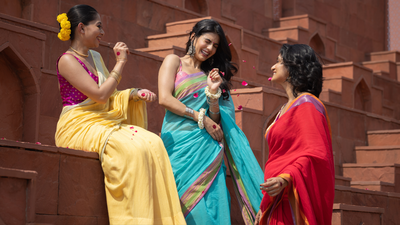
Whenever there is a wedding, celebration, or pooja in the family, we often notice several women donning sarees and decked in accessories from head to toe.But what about an ordinary Tuesday, with no function, no dress code, and nobody watching?Still, some women put on sarees and drape them with the ease of someone who has done it a thousand times.We often explain this with quick words like “traditional” or “old-school.” But when watched closely, they are often modern, working, travelling, and quite sure of themselves, and their choices are more like a quiet statement they don’t need to say out loud.What we wear is one of the first decisions we make each day, and the small, repeated choices often show our sense of self most honestly.So what might a woman be saying when she picks a saree for no one but herself?Let’s look at the psychology behind it.
What do the choices of clothes do to the person wearing them
Psychologists Hajo Adam and Adam Galinsky introduced the term “enclothed cognition” in a 2012 paper, saying clothes affect how the wearer thinks and feels through two things together: what the clothes symbolise and the physical experience of wearing them. The term describes “the systematic influence that clothes have on the wearer’s psychological processes.”For a saree, the symbolism can be associated with heritage, grace, or family. It is also the physical experience associated with the drape and the pleats, and the way it changes how a woman walks and carries herself.
What do women feel when they wear a saree?
Researcher Shauna Wilton interviewed young Indian women about their clothing to study how the sari connects to identity and the nation. According to Wilton, choosing a sari does not always reflect a conscious choice of Indianness, but everyday clothing choices do help women tackle social and cultural identities also.But wearing a saree can also be an expected choice shaped by family and region. So when a woman wears one unprompted, it may also be about identity, habit, or both.
What women themselves say
A community research project by Bridge Roots spoke with women in India and the diaspora. The community-led project says that the sari functions as “a cultural narrative.” Many of the women who took part said that wearing a saree makes them feel close to their family, their roots, and their community. Many also said they don’t just copy what earlier generations did. They adapt the tradition in their own way.A small 2022 survey of 50 women, most of them working, found that the majority simply enjoyed wearing a saree. Almost all of them, about 96%, said they would miss it if it went missing.