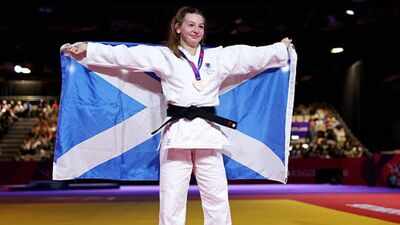
You can be at the peak one moment and then at the base the next. That’s how unpredictable life’s highs and lows can be. For a 22-year-old Scottish athlete who won the country a bronze medal at the Commonwealth Games 2026, life returned to normal with her shifts at McDonald’s continuing. Judo competitor Summer Shaw shared a TikTok about her story, where she earned Scotland’s first judo medal at the international sporting event, and then returned to her part-time job at the eatery as a crew trainer.“And that’s on doing a sport no one cares about … someone sponsor me so I don’t have to work,” the 22-year-old captioned her TikTok shared on Aug. 7, adding hashtags like #athletelife #sponsorme #help and #diva. As of August 21, her TikTok had been viewed 1.5 million times, as per PEOPLE.At the games, Shaw competed against seven nations in the women’s 48 kg judo competition in Glasgow, Scotland on July 31, taking home a bronze behind Canada’s Heidi Quach (silver) and India’s Asmita Dey (gold). But days later, she returned to her part-time job in Surrey, which she works to pay to travel to judo competitions, according to Kennedy News and Media.“I’m already paid to do judo. The amount I get from that basically covers rent, petrol and food and nothing else,” Shaw explained.“It was strange [to be back at McDonald’s after the win], but it almost gives you that sense of normality,” she continued. “It’s important to have a social life that’s separate from your sport. People at work just see me as a bit more of a normal human being.”However, when she returned to work after her historic victory, one colleague did wonder about the trajectory. “I did have a co-worker say to me, ‘It’s crazy how you can be near the top of your game in a sport and then be working here,’ ” the athlete recalled. “In my opinion, I’m not quite there yet. There’s still a way to go.”Shaw is given what is called an ‘Athlete Performance Award’ (APA), a financial grant from UK Sport and the National Lottery that contributes towards her living and training costs. There are different grades of support, external that athletes receive, depending on their results and prospect of medal-winning performances. Shaw told BBC Sport that it was “very common” for athletes in sports like judo to have another source of income.“The money I get [APA] covers my living expenses, which is a blessing and not to be taken for granted. But, for example, the next competition I’ve paid for myself because it wasn’t funded by British Judo. Going to Peru [for the Grand Prix] has cost me quite a bit of money and then I’m not really getting that back from anywhere else. I’m also a normal person! Like, I want to save for a house,” she said.Shaw also put her experience in comparison to other athletes. “So many sports that are smaller, like judo, it must be so common [to have another job],” she said. “For me, it’s about having a job that is that flexible. It’s a bit of a balance of how much the athlete needs the money as opposed to when they should be resting.”“But if I know I need to pay for myself to go to a competition, I know I need to start working more so that I can afford it,” Shaw concluded.She has recently been based largely in Birmingham while studying for a biology degree. That means she has been close to the British Judo Olympic and Paralympic National Training Centre in Walsall. Shaw also decided to set up a GoFundMe page at the start of the year, which she sees as a way of helping to fund her dream of going to the 2028 Los Angeles Olympics.