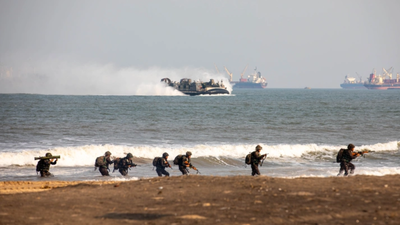
India and the United States have begun the fifth edition of the bilateral Exercise Tiger Triumph in Visakhapatnam. The aim if this edition of the exercise is to improve interoperability for Humanitarian Assistance and Disaster Response (HADR), tabletop staff planning and integrated multi-domain command and control. Tiger Triumph is the only tri-service exercise India takes part in apart from Exercise INDRA which is held with Russia.US Pacific Fleet vice commander Rear Admiral Joaquin Martinez de Pinillos said that the exercise reflects the “growing strength, sophistication and shared commitment” of the US-India major defense partnership. The American Admiral went on to add that the exercise sharpens combined operational coordination and prepares both forces to respond quickly to crises and natural disasters in the region. Rear Admiral Vishal Bishnoi, Flag Officer Commanding Eastern Fleet, said the exercise gives practical expression to the relationship by bringing together “complementary capabilities of our armed forces” in a demanding HADR settings.This edition of the exercise brings together staff planning, all-domain tabletop exercises and specialised command, control, cyber and space synchronisation. Personnel from both sides will also and hold subject-matter expert exchanges.
From disaster relief to multi-domain planning
The exercise has grown steadily since its first edition in 2019 that was held at Visakhapatnam and Kakinada, was the first tri-service exercise India held with the US. The fourth edition took place in Visakhapatnam in April 2025. This year’s emphasis on space, cyber and command and control shows how far the series is evolving.The exercise comes as both countries deepen their strategic partnership. They are part of the Quad with Japan and Australia, and of I2U2 with the UAE and Israel. New Delhi and Washington promote a free, open and secure Indo-Pacific, even as China grows more assertive in the region. Both India and China fall under the area of operations of the US Indo-Pacific Command, the largest US command by area.
A widening defence relationship
India buys from Russia, the US, France, Israel and others while expanding domestic manufacturing. It operates American-origin platforms such as the C-17 and C-130J transports, P-8I maritime patrol aircraft, Apache and Chinook helicopters, MH-60R naval helicopters and M777 howitzers, and talks with Washington have extended to co-production and technology transfer. The sanctions after India’s 1998 nuclear tests, and the possibility of action under CAATSA after the S-400 purchase, remain part of that background.High-level military contacts have been frequent. In the last year, the then chiefs of all three services visited the US. Admiral Dinesh K Tripathi, now retired, visited from November 12 to 17, 2025. Air Chief Marshal AP Singh, who retired recently, went from April 6, 2026, and General Upendra Dwivedi travelled in April 2026, a few months before his retirement.India conducts a large number of exercises with the US across services, among them Yudh Abhyas, Vajra Prahar, Malabar and Cope India, besides multilateral drills such as RIMPAC and Sea Dragon. Its role as an associate partner in the Combined Maritime Forces reflects shared maritime security priorities. Tiger Triumph 2026 adds another layer to that record, and the shift from disaster response to cyber and space planning suggests where the partnership is heading.