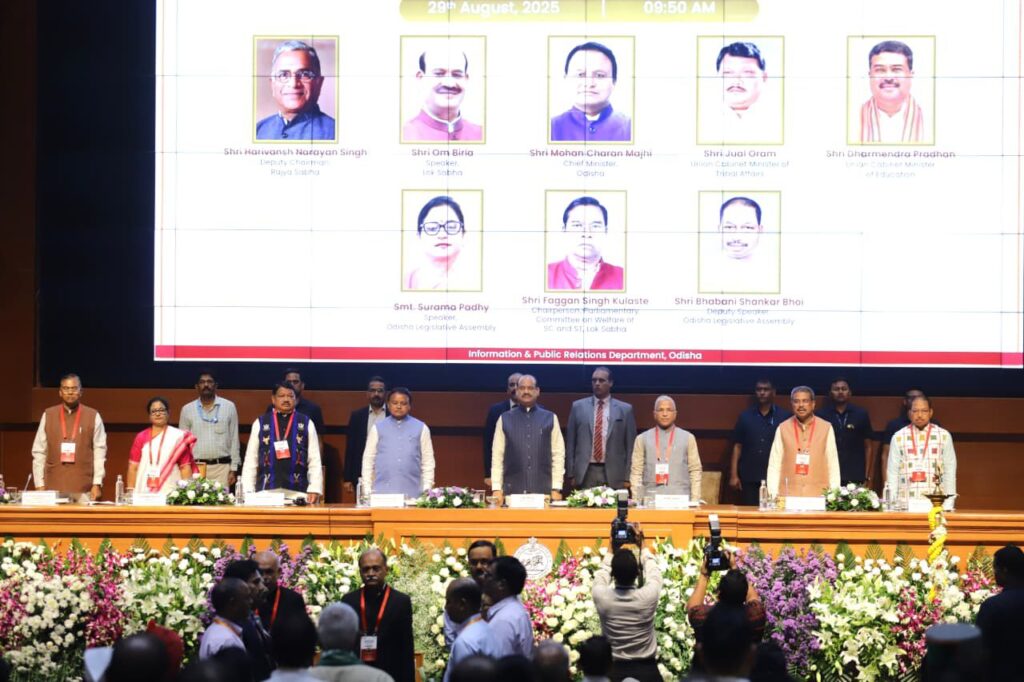
SC/ST Welfare Committees Conference: Lok Sabha Speaker Shri Om Birla, today, urged the lawmakers of the country to rise above party lines on issues of national interest. He expressed anguish on decline in number of sittings of legislatures and disruptive behaviour of members in legislative bodies. Inaugurating the National Conference of Chairpersons of Committees of Parliament and State Legislatures on the Welfare of Scheduled Castes and Scheduled Tribes in Bhubaneswar, Odisha, Shri Birla said that decline in the level of discussion and dialogue in legislatures is a matter of concern.Shri Birla reaffirmed the timeless vision of the Constitution, and underlined that social justice and equality of opportunity are not only the defining features of our Constitution but also the guiding spirit of India’s democratic journey for the last 75 years. Recalling Dr. B.R. Ambedkar’s vision of an India where Scheduled Castes, Scheduled Tribes, and marginalised sections would live with dignity, respect, and equal opportunities, Shri Birla noted that this vision has taken concrete shape over the decades, enabling members of these communities to occupy the highest offices of the land, thereby reflecting the maturity and inclusiveness of Indian democracy.The First Conference of Chairpersons of Committees on the Welfare of SCs and STs was held way back in 1976 in New Delhi. Thereafter, successive Conferences have been held in 1979, 1983, 1987and 2001, contributing to robust dialogue on the varied dimensions of welfare and constitutional safeguards for SCs and STs. However, it is for the first time that such a Conference is being organized outside Delhi.Shri Birla emphasized the critical need for effective utilisation of government funds and robust monitoring mechanisms to ensure that welfare schemes truly reach and empower the marginalized sections of society and highlighted the pivotal role that financial discipline and administrative accountability play in driving inclusive development.He noted that substantial public resources are allocated each year toward social welfare initiatives aimed at uplifting Scheduled Castes, Scheduled Tribes, and other marginalised sections and underscored the importance of timely implementation and regular monitoring to ensure that the benefits of development are equitably distributed. Stressing that true empowerment goes beyond financial aid and must foster self-reliance, dignity, and opportunities for growth, the Speaker reiterated the Parliament\’s commitment to social justice and inclusive governance through more responsive and result-oriented policy execution.
Highlighting the important role of Committees, Shri Birla said that they are the backbone of parliamentary democracy. Unlike the political compulsions that drive debates in the House, he said that Committees examine issues in detail, free from partisan politics, and arrive at consensus-based recommendations. He dwelt at length on how Committees, particularly those dealing with the welfare of Scheduled Castes and Scheduled Tribes, scrutinise budgetary provisions minutely, evaluate the performance of schemes, and assess whether allocations have been fully and effectively utilised. Their reports, he said, not only hold the government accountable but also provide valuable guidance for course correction.He further noted that the Committees of Parliament and State Legislatures function in a non-partisan manner, rising above political lines to take decisions solely in the interest of the people. Their discussions, more detailed and structured than those held in the House, provide clarity and direction to government policies and help secure consensus on sensitive issues. Shri Birla pointed out that this strength of our institutions has enabled India to translate policies into real empowerment, as reflected in the rise of leaders from marginalised communities to the highest offices.Stressing that the constitutional provisions guaranteeing equality before law, equal protection of laws, and justice — social, economic, and political — have proved to be the bedrock of India’s progress. These ideals, enshrined in the Preamble of the Constitution, remain the touchstone for governance and the guiding light for institutions. He emphasised that only when the principles of equality and justice reach the last citizen will democracy achieve its full meaning and strength.Shri Birla observed that India’s journey over the last seven and a half decades has been a constant endeavour to empower the most disadvantaged. Today, public sector undertakings, financial institutions, and educational reforms such as the National Education Policy are all aligned towards expanding opportunities for Scheduled Castes and Scheduled Tribes. He reiterated that education and social justice go hand in hand, and protection of the rights of weaker sections must remain at the centre of the nation’s policy agenda.