The world is asking bigger economic questions than it has in decades. Why hasn’t the world seen more inflation, despite over a decade of massive money-printing? Is the dollar still dominant because it’s the best currency—or simply because there’s no viable alternative? Is China’s property crash over — or is the bubble psychology still there?
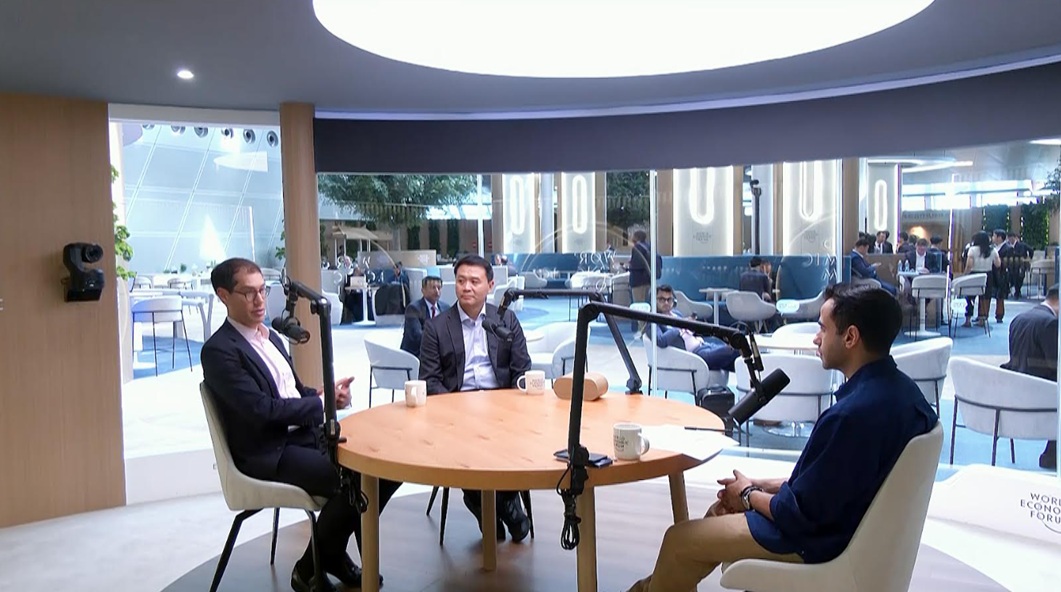 |
Matthew Klein and Professor Ning Zhu with Nikhil Kamath on People by WTF
In the latest episode of People by WTF, Nikhil Kamath sits down with economist and author Matthew Klein, co-author of Trade Wars Are Class Wars, and Professor Ning Zhu, author of China’s Guaranteed Bubble. Recorded in China, the conversation moves beyond headlines to examine the forces reshaping the global economy—from China’s slowing property market and America’s growing debt to trade imbalances, financial markets and the future of globalisation.
One of the episode’s liveliest exchanges begins when Kamath questions why investors continue lending to the US government at roughly 4% despite record levels of debt. If America’s borrowing keeps growing, why does the world still treat US Treasuries as one of its safest assets? Klein points to confidence in future US growth and inflation; Zhu points to something simpler—no other market offers the scale and liquidity that reserve managers need. Asked where yields might be in ten years, Klein pushes back on market consensus, arguing they could actually rise if AI-driven investment lifts returns across riskier assets—and cautions against assuming an ageing population pushes rates up by default, since the research behind that claim comes largely from young, fast-growing societies rather than truly aged ones like Japan. Zhu’s answer stays simpler: safety still beats yield, and by that measure, the US has no real competitor.
The discussion naturally turns to the future of the US dollar and China’s ambition to internationalise the renminbi. Both economists agree de-dollarisation requires a credible alternative, not just dissatisfaction with the dollar — and argue neither the renminbi nor the euro has built the deep, open capital markets needed to become one. Klein points to a counterintuitive twist: dollar-backed stablecoins may be entrenching the dollar’s dominance further, offering a faster, cheaper way to transact in dollars even as de-dollarisation rhetoric grows louder. Zhu sees the exchange rate as the natural pressure valve for trade imbalances looking ahead—the renminbi, after a decade-long 30% devaluation, has already appreciated 10–15% since last summer, though he acknowledges China’s trading partners still see the adjustment as too slow.
The conversation also overturns conventional assumptions about how markets respond to major events. Klein recalls how Japan’s 1995 Kobe earthquake unexpectedly strengthened the yen rather than weakening it, illustrating that capital flows, liquidity, and investor positioning often matter more than conventional economic logic. The example becomes a broader reminder that markets rarely behave as textbooks predict.
One of the episode’s more provocative moments comes when Kamath asks why inflation hasn’t returned despite years of aggressive monetary stimulus. Zhu offers a theory: much of that liquidity didn’t vanish; it flowed into asset prices instead — US stocks, Chinese property before 2021 — quietly building wealth inequality rather than showing up in the CPI, with consequences he links to today’s political polarisation.
Behavioural economics becomes a central theme. Drawing on his research into China’s housing bubble, Zhu explains how governments, developers and consumers gradually convinced themselves that property prices could only move in one direction—a pattern Kamath recognises instantly in India, where developers insist land prices never fall. Zhu argues stronger property taxes are one of the few real correctives, since they discourage the speculation that lets such beliefs take hold in the first place.
The discussion expands beyond China and the United States to examine a world becoming increasingly fragmented, where geopolitics, demographics and inequality are reshaping trade, investment and policymaking. Both guests describe India as one of the world’s most promising long-term growth stories while calling for greater economic understanding as global interdependence evolves.
The episode closes on a note of humility rather than prediction. Asked what comes next for China, the dollar and the global economy, Zhu offers a simple piece of advice, besides positing that change is the only constant: “Embrace whatever comes.” It is a fitting conclusion to a conversation that repeatedly argues that adaptability—not certainty—may prove the world’s most valuable economic advantage.
The episode explores not just what is changing in the global economy, but how those shifts could influence investment, business and policymaking in the years ahead. The episode is available now on YouTube, Spotify and all major podcast platforms.
Notes to the Editor
Guests
-
Matthew Klein — Founder and publisher of The Overshoot, a subscription research service on the global economy. Former economics commentator at Barron’s. Previously wrote for the Financial Times, Bloomberg View and The Economist. Former research associate at the Council on Foreign Relations and investment associate at Bridgewater Associates. Co-author with Michael Pettis of Trade Wars Are Class Wars: How Rising Inequality Distorts the Global Economy and Threatens International Peace (Yale University Press, 2020), described by Martin Wolf of the Financial Times as “a very important book.”
-
Professor Ning Zhu — Deputy Dean and Chair Professor of Finance at the Shanghai Advanced Institute of Finance (SAIF), Shanghai Jiao Tong University. Faculty Fellow at Yale University International Center for Finance. Former Chair Professor at Tsinghua University and former senior executive at Lehman Brothers and Nomura Securities (Hong Kong). Author of China’s Guaranteed Bubble and The Investor’s Enemy. Adviser to the People’s Bank of China, the China Securities Regulatory Commission, the World Bank, the IMF and numerous institutional investors. Regular speaker at the World Economic Forum and the Boao Forum for Asia.
Books Referenced
-
Trade Wars Are Class Wars by Matthew C. Klein and Michael Pettis (Yale University Press, 2020) — Examines how domestic political choices and rising inequality shape global trade imbalances.
-
China’s Guaranteed Bubble by Ning Zhu (McGraw-Hill) — Argues that implicit state guarantees lay at the heart of China’s financial system and predicted the country’s property market crisis before it unfolded.
Related Episodes Across the WTF Network
-
Howard Marks (WTF): Explores how historical experience shapes risk-taking and investment behaviour, providing context for the discussion on financial cycles and housing bubbles.
-
Ruchir Sharma (WTF is Finance): Examines China’s provincial growth model and its long-term impact on trade surpluses, currency dynamics and capital controls.
-
GV Prasad and Rajeev Juneja (WTF): Discusses how China built a globally competitive innovation ecosystem, complementing Zhu’s analysis of China’s transition towards advanced manufacturing.
-
President Nikos Christodoulides of Cyprus (WTF): Explores the changing global order and the institutions that may shape the next phase of international cooperation, providing geopolitical context for the economic themes discussed in this episode.
Key Themes Discussed:
-
China’s K-shaped economy and the shift towards advanced manufacturing
-
China’s post-pandemic trade surplus and the role of tariffs
-
The future of the US dollar and de-dollarisation
-
China’s housing crash and the psychology behind financial bubbles
-
Memory, sentiment and long-term economic behaviour
-
Capital controls and cross-border capital flows
-
Demographic change and its impact on global growth
-
The balance between economic efficiency and fairness
-
Cryptocurrency as a diversification tool rather than a sovereign currency
-
India’s manufacturing ambitions and long-term competitiveness
About People by WTF
People by WTF is a global podcast platform hosted by Nikhil Kamath, featuring in-depth conversations with leaders across business, policy, technology, culture and academia. The show explores long-term institutional, technological and economic questions shaping global society through candid, high-signal dialogue. Past guests include Elon Musk, Prime Minister Narendra Modi, Bill Gates, Rishi Sunak, Akshata Murty, Martin Escobari and Ranbir Kapoor.