India’s pet care market is projected to surpass Rs. 11,000 crore by 2031, growing at a CAGR of 8% between 2026 and 2031, according to a new Euromonitor International report, Pet Care in India: Shaping a Resilient and Inclusive Companion Care Landscape, unveiled at the CII India Petcare Summit 2026. Yet the report’s central message is not the scale of the opportunity but what stands between the industry and it: the next phase of growth, it argues, will be won on stronger regulatory foundations, deeper veterinary capacity and closer collaboration across the ecosystem, not demand alone.
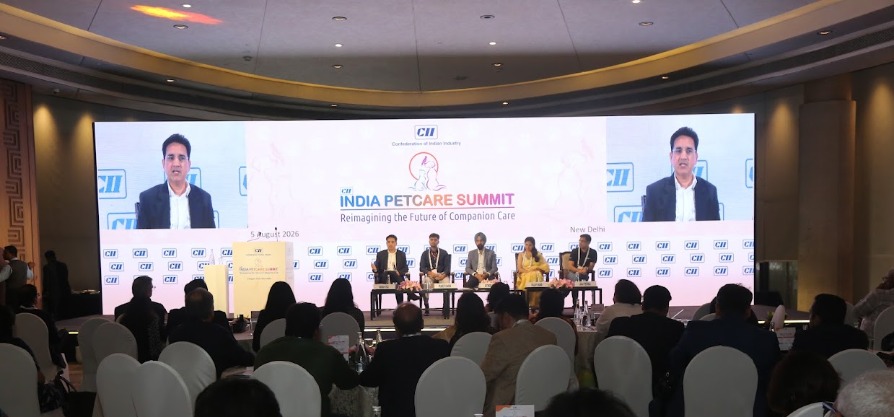 |
CII India Petcare Summit 2026
That tension framed a day of discussion. Organised by the Confederation of Indian Industry (CII) under the theme “Reimagining the Future of Companion Care,” the summit convened policymakers, regulators, standards experts, veterinarians and industry leaders to deliberate on building a robust companion animal ecosystem. The conversations centred on strengthening India’s regulatory framework, advancing science-based nutrition, expanding veterinary capacity, promoting responsible pet ownership and fostering innovation — set against a generational shift in which Millennials and Gen Z increasingly treat pets as family and are driving demand for premium, health-focused nutrition.
Addressing the inaugural session, Dr. Naveena Kumar, Animal Husbandry Commissioner, Department of Animal Husbandry and Dairying, Government of India, pointed to the rapid evolution of the sector and called for science-based nutrition, stronger regulatory frameworks, sustainable manufacturing, ethical breeding practices and greater investment in research and veterinary infrastructure.
Dr. Sujit Kumar Dutta, Joint Commissioner, Department of Animal Husbandry and Dairying, Government of India & Secretary, Animal Welfare Board of India, pressed the case for stronger veterinary infrastructure, skilled manpower, expanded domestic manufacturing and robust regulatory standards to underpin responsible, sustainable growth.
The inaugural panel, “From Labels to Laws – Building India’s Future-Ready Pet Food Regulatory Ecosystem,” moderated by Manish Syag, Managing Director, Mars Pet Nutrition India, turned to a practical question: how to build a collaborative, science-led regulatory framework that earns consumer trust and improves transparency without slowing the category down.
Manish Syag, Managing Director, Mars Pet Nutrition India, said, “India’s pet care industry has tremendous headroom for growth. Today, only 9% of dogs and 27% of cats are fed packaged pet food, even though pet food contributes 86% of the category’s retail value. As more pet parents embrace quality nutrition and access expands across the country, science-based regulation will be a critical enabler of this growth. Clear, globally aligned standards build consumer confidence, support responsible innovation and give manufacturers the certainty to invest in local capabilities. For us, everything begins with the pet at the centre of the home, and by working together across government, standards bodies, veterinarians and industry, we can build a trusted ecosystem that advances responsible pet ownership while positioning India as a global hub for world-class pet nutrition.”
Pradeep Sharma, Scientist-C & Deputy Director, Food & Agriculture Department, Bureau of Indian Standards, said, “The revision of India’s pet food standard is aimed at aligning it with the latest scientific developments and global best practices while strengthening transparency through improved labelling and quality requirements. Effective implementation of these standards will help build consumer trust, create a level playing field for manufacturers and strengthen India’s position as a globally competitive hub for pet food manufacturing and exports.”
Satinder Singh, Managing Director, Royal Canin, added, “A future-ready pet care ecosystem must be built on three pillars, pets first, science and trust. Science-based regulations can improve transparency, encourage innovation and help build consumer confidence while enabling the industry to grow responsibly.”
The panel also brought together Pallavi Anand, Business Head, Nestle Purina Petcare, South Asia Region; Satinder Singh, Managing Director, Royal Canin; and Aman Tekriwal, Co-founder, Supertails. A recurring theme was the role of clear, standardised labelling in helping pet parents interpret ingredients, nutritional content, feeding guidelines and evidence-based claims — and, from there, make informed choices. Speakers argued that regulation should encourage innovation while aligning with global scientific standards, backed by stronger consumer education and closer coordination between industry, veterinarians, policymakers and digital platforms.
Inside the Euromonitor report
-
The headroom is the story. Only 9% of dogs and 27% of cats in India are currently fed packaged pet food, a gap that widens as e-commerce and quick commerce push beyond the metros.
-
Pet food dominates the basket. It accounts for nearly 86% of India’s pet care retail value, with the market projected to reach Rs. 11,167 crore by 2031.
-
A generational demand shift. Pet ownership is expected to grow at a CAGR of 5%, led by Millennials and Gen Z who view pets as family and are driving demand for premium, health-focused nutrition.