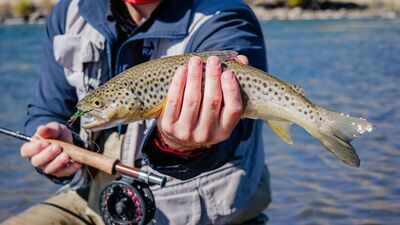
For more than a century, California’s high mountain lakes were stocked with trout to make remote wilderness more attractive to anglers. Between 1870 and 1988, fish were carried or flown into lakes and streams that had historically been fishless, creating new opportunities for recreation but also changing the balance of life in the Sierra Nevada. The introduced trout ate mountain yellow-legged frogs, their tadpoles and the insects the amphibians depended on. Over time, the once abundant frogs disappeared from about 92 percent of their historic range. As explained by the National Park Service (NPS), the story is one of unintended consequences, where a decision made to support fishing transformed fragile alpine ecosystems. Today, park managers are removing nonnative fish from selected waters and restoring the habitats where the frogs evolved without major aquatic predators.Fish in naturally fishless lakesThe Sierra Nevada contains thousands of lakes, ponds and marshes scattered across high elevations. Before modern fish stocking, many of these waters were naturally fishless. Steep waterfalls, dry stretches and other landscape barriers prevented trout from reaching them from lower rivers.That absence of fish shaped the evolution of the mountain yellow-legged frog. The amphibians were able to live and reproduce in lakes where their eggs, tadpoles and adults faced relatively few aquatic predators. They became an important part of high-elevation food webs, feeding on insects and other small organisms while serving as prey for birds, snakes and mammals.The lakes were not empty or lifeless. They supported specialised communities adapted to short summers, cold water and long winters beneath snow and ice. Mountain yellow-legged frogs could spend much of the year in frigid conditions, with their life cycles timed to the brief period when alpine waters warmed enough for breeding and tadpole development.When trout were introduced, they entered a system that had not evolved with them. The fish found abundant prey and few natural controls. What looked like an improvement for anglers became a major ecological disruption for frogs.The appeal of stocking troutFish stocking expanded during the late 19th and 20th centuries as government agencies, fishing groups and recreation advocates sought to make remote lakes more useful to people. Trout were considered desirable game fish, and their presence could attract visitors to mountain areas that were otherwise difficult to reach.From 1870 to 1988, nonnative trout were introduced into high elevation lakes and streams in the area now protected by Sequoia and Kings Canyon National Parks. The fish included California golden trout, brook trout and brown trout. Some populations became self-sustaining, meaning they no longer needed regular stocking to remain in the lakes.For anglers, the change was appealing. A hike into the mountains could end with a chance to catch trout in a clear alpine lake. The stocking programme helped promote tourism and outdoor recreation, and at the time, the ecological consequences were not fully understood.The high country was often treated as a blank space waiting to be improved for human use. The fact that many of the lakes had never contained fish was not initially seen as a sign of ecological specialisation. It was seen as an opportunity.A predator the frogs had never facedThe mountain yellow-legged frog had evolved to survive in cold, difficult environments, but trout created a new kind of threat. The fish could eat frog tadpoles and adults, especially in the shallow water and rocky margins where amphibians breed and feed.Trout also consumed aquatic insects. That created competition for food, because insects are a major part of the frogs’ diet. Even when trout did not directly eat every frog, they could reduce the availability of prey and alter the structure of the food web.The impact was strongest in lakes and streams where frogs had historically been common and trout populations could reproduce. Some frog populations vanished from individual waters within years or decades. As fish spread between connected habitats, the decline became regional.The frogs were not simply losing a few isolated ponds. They were being removed from entire sections of their range, including breeding sites that had supported them for thousands of years.A dramatic range lossThe NPS describes mountain yellow-legged frogs as once being among the most numerous amphibians in the Sierra Nevada. Today, they have disappeared from 92 percent of their historic range.That figure captures the scale of the decline, but it does not fully express what it means on the ground. In many places, a visitor can stand beside a lake that appears pristine and see no sign of the frogs that once filled its shallows. The water may be clear, the shoreline rugged and the surrounding forest healthy, yet the ecosystem has changed because of one introduced predator.The loss also makes remaining populations more vulnerable. When amphibians survive in only a small fraction of their former habitat, disease, drought, wildfire and climate change can have greater effects. A problem in one lake may no longer be buffered by healthy populations in nearby waters.The frogs face additional pressures, including the fungal disease chytridiomycosis, which has caused severe declines in amphibian populations around the world. Habitat disruption from trout has made recovery more difficult by leaving fewer safe breeding sites.Removing fish from the high countryOnce scientists understood the connection between trout and frog declines, conservation managers began exploring fish removal. In Sequoia and Kings Canyon National Parks, efforts began in 2001 to restore selected lakes and streams to their naturally fishless condition.Removing trout from remote mountain waters is difficult. Crews may use nets, electrofishing equipment and repeated surveys to capture fish. The work often requires hiking or transporting equipment through steep terrain. Because some trout populations can reproduce quickly, a single removal effort may not be enough. Managers must return to the lake and confirm that fish have not survived or recolonised it.By 2011, nearly 44,000 fish had been removed from 19 lakes, including complete removal from nine lakes. Those projects were not intended to eliminate trout from every mountain waterway. Instead, managers selected sites where fish removal could provide the greatest benefit for endangered frogs and where long term restoration was feasible, as per the report.The strategy reflects a shift in priorities. Some lakes remain important for fishing, while others are being managed primarily as refuges for native amphibians and the ecological communities that depend on fishless conditions.What recovery looks likeRestoring a lake does not guarantee that frogs will return immediately. Populations may have disappeared from nearby areas, and remaining frogs may need assistance reaching restored habitat. Disease can also affect reintroduction efforts.When trout are removed, however, the ecological conditions become more favourable. Tadpoles have a better chance of surviving, adults can use shallow breeding areas without constant predation and insect populations may recover. Over time, these changes can support the return or reinforcement of frog populations.The NPS has used a combination of habitat restoration, monitoring and captive breeding or translocation efforts to support recovery. Scientists track frog numbers, breeding success, disease and water conditions. They also monitor fish populations to ensure that restored waters remain free of trout.Recovery is measured in years rather than weeks. Mountain environments have short growing seasons, and amphibian populations can fluctuate naturally. A lake that once supported thousands of frogs may take considerable time to regain a stable population.A change in the meaning of recreationThe trout stocking story raises a difficult question about how public lands should be managed. Fishing is a valued recreational activity, and many visitors connect mountain lakes with the possibility of catching fish. At the same time, the absence of fish is not a deficiency in a natural system. It can be one of the features that makes an alpine lake ecologically important.The challenge is to balance human recreation with the protection of native species. In some waters, trout fishing can continue. In others, fish removal may be necessary to protect frogs that exist nowhere else. Clear communication can help visitors understand why a lake that looks suitable for fish is being restored to a fishless condition.This approach also shows that conservation is not always about adding species or increasing opportunities. Sometimes it requires removing an animal that people value because it does not belong in that particular ecosystem.Lessons from a century of interventionThe history of Sierra Nevada trout stocking is a reminder that well intentioned environmental actions can produce consequences that emerge slowly. The original goal was straightforward: create fishing opportunities and attract recreationists. The long term result was the transformation of high elevation aquatic ecosystems and the loss of frogs from most of their historic range.Modern conservation is now trying to reverse part of that change. The work is expensive and technically challenging, but it offers a chance to restore habitats that remain suitable for the frogs. It also provides a broader lesson about ecological limits. Before altering a remote environment, managers need to understand what may be lost, not just what may be gained.The mountain yellow-legged frog’s decline shows the cost of overlooking that question. A clear lake filled with trout may appear healthy to a visitor, but it may represent the disappearance of a native amphibian community that once defined the landscape.Bringing back a native soundIn the Sierra Nevada, restoring yellow-legged frogs is about more than saving one species. It is about rebuilding high mountain ecosystems in which water, insects, amphibians, birds and forests interact as they did before the stocking era.A restored lake may eventually sound different. Instead of being valued mainly for the fish it contains, it can once again support the seasonal chorus of frogs along its shoreline. Tadpoles can move through shallow water without being hunted, and native food webs can recover some of their former complexity.The trout introduced between 1870 and 1988 changed the mountains in ways that lasted generations. Removing them from selected waters cannot erase the past, but it can create space for the future. For the mountain yellow-legged frog, that space may be the difference between surviving in scattered remnants and returning to a meaningful part of its Sierra Nevada home.