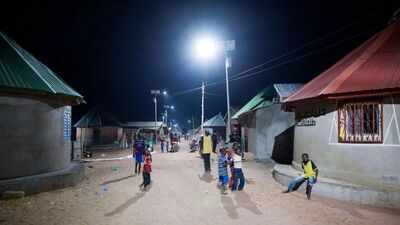
Long before solar energy became a major part of conversations around Africa’s development, Akon was trying to tackle one of the continent’s most basic challenges: access to electricity.In February 2014, the Senegalese-American singer launched Akon Lighting Africa, an initiative focused on using solar power to provide electricity to communities that were not connected to reliable power networks. The project was founded by Akon along with Thione Niang and Malian entrepreneur Samba Bathily.The idea was ambitious from the beginning. The initiative initially set out to bring electricity to one million African households by the end of 2014, with a particular focus on rural communities. Its approach involved solar equipment for homes as well as public infrastructure, rather than relying solely on conventional electricity grids.
Why Akon wanted to focus on electricity
For Akon, the project was connected to his own childhood experience in Senegal. He and co-founder Thione Niang grew up in Kaolack, a town where access to electricity was limited. The initiative’s official account says those experiences of growing up without reliable power helped shape their decision to make energy access a priority. The reasoning behind the project went beyond simply putting lights in homes. Lack of electricity affects education, healthcare and economic activity.
Solar power became the answer
Instead of waiting for conventional electricity infrastructure to reach remote communities, Akon Lighting Africa promoted off-grid solar solutions.The programme worked through partnerships involving governments, businesses and organisations connected to the project. Its solutions included solar streetlights, household solar kits, community systems and solar-powered equipment.The model was also designed around financing. A 2015 statement from the initiative said solar systems were pre-financed so that equipment could be deployed more quickly, while governments and other partners participated in the wider process.
From a 2014 launch to 14 countries
By August 2014, only months after the initiative was launched, a report from Northwestern University’s Medill News Service said Akon had stated that solar installations had already reached 14 African nations. At that point, the project had completed about a quarter of its stated one-million-household target, according to the report.The initiative’s own subsequent overview similarly says that in less than one year, solar solutions including streetlights and domestic and individual kits had been installed in 14 African countries.Those countries included Mali, Senegal, Niger, Guinea, Burkina Faso, Sierra Leone, Benin, Equatorial Guinea, Gabon, the Republic of Congo, Namibia, Madagascar, Kenya and Nigeria.The rapid expansion was not limited to individual houses. According to the initiative, projects reached villages, community buildings, schools and health centres, with some rural communities receiving electricity for the first time.
More than streetlights
The programme was built around the idea that electricity could change how communities function after sunset.Solar streetlights could illuminate roads and public spaces, while household systems could provide lighting and allow residents to charge phones and use basic electrical devices. The initiative also highlighted employment opportunities created through the installation and maintenance of solar equipment, particularly for young people.The project’s focus later expanded to training as well. Akon Lighting Africa and its partners developed the Solektra Solar Academy in Bamako, Mali, aimed at training young Africans in solar technology, including installation and maintenance.
The bigger ambition
Reaching 14 countries was presented as an early stage rather than the end goal.A 2015 United Nations Sustainable Energy for All forum document said the initiative had already reached 11 countries at that point and was seeking to accelerate rural electrification threw off-grid solar solutions.The project’s longer-term plans were considerably larger. Its stated ambition was to expand across more African countries and address energy access on a continental scale. Later project material lists 25 countries where it had projects or planned phases.The initiative also attracted attention from international organisations. In May 2015, its founders were invited to the United Nations and World Bank-backed Sustainable Energy for All Forum, where the project was presented as an example of a market-based approach to expanding energy access.Akon’s project therefore became notable not simply because a major music star entered the energy sector, but because of how quickly the initiative attempted to move from an announced goal to physical solar installations across multiple African countries. Launched in February 2014 with a target of bringing electricity to one million households, Akon Lighting Africa had reached 14 countries in less than a year, according to the project’s own account and contemporary reporting. Its work combined solar technology, public-private partnerships and local employment with a much larger objective: finding practical alternatives for communities that conventional electricity infrastructure had not yet reached.