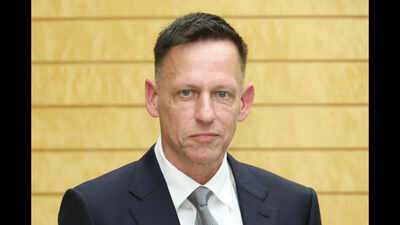
Billionaire investor Pete Thiel feels that Germany lacks global-scale entrepreneurs like Elon Musk or Mark Zuckerberg because the country suffers from a “fear of success.” He argues that German founders often exit early instead of scaling companies into global giants, leaving the nation behind in innovation and wealth creation. According to a report by Fortune, speaking on the MDMEETS podcast, Thiel said German entrepreneurs are not only risk-averse but also hesitant to embrace success at scale. “If you have something that works—you’re not going to scale it to this extreme degree like an Elon Musk or Mark Zuckerberg,” he explained. Instead, founders tend to sell or exit before their companies become truly global businesses.Thiel contrasted this with the US, where entrepreneurs aggressively expand successful ventures, creating thousands of jobs and new millionaires. He noted that Germany has produced few major new companies in recent decades, despite being Europe’s largest economy.
Germany’s standing in global business rankings continues to slip
Thiel’s comments come as Germany’s standing in global business rankings continues to slip. For the first time in the four-year history of the Fortune 500 Europe list, the UK has overtaken Germany as the country with the most companies represented, 76 to 73. Germany also lags in innovation more broadly — the country holds only a fraction of the unicorn startups found in the US and China, and ranked just 10th in the European Union’s 2026 Innovation Scoreboard, trailing smaller economies like Austria, Luxembourg, and Ireland.
Peter Thiel : Inherited wealth versus self-made wealth reveals a generational divide
Thiel also drew a sharper contrast between how wealth is generated among the richest people in Germany versus the US. By his own estimate, roughly a dozen of America’s 50 wealthiest people are Gen X or younger, and most of them built their fortunes from scratch. In Germany, he counted around 20 people in that same age bracket among the wealthiest — but said, in his assessment, every single one of them inherited their wealth rather than building something new.He argued that the difference matters beyond personal wealth accumulation: each of the US entrepreneurs he pointed to didn’t just build a fortune for themselves, but created thousands of millionaires among their employees and tens of thousands of additional jobs, contributing to the broader economy in the process — a ripple effect he suggested is largely missing in Germany’s wealth landscape.
Germany’s industrial giants are struggling too
Thiel’s broader critique lands at a difficult moment for Germany’s traditional economic engine: its automotive industry. Volkswagen, long Europe’s largest company by revenue, ranked as high as No. 6 globally on the Fortune Global 500 in 2017, but has since fallen to No. 13, weighed down by its emissions scandal and intensifying competition from Chinese EV makers. The company recently approved a major restructuring plan that includes cutting its model lineup roughly in half and eliminating 50,000 jobs, on top of another 50,000 cuts already agreed to over the past two years — with its stock down more than 35% year to date.Volkswagen isn’t alone in that struggle. Fellow German auto giants BMW and Mercedes-Benz, ranked No. 50 and No. 51 on the Global 500 respectively, have also seen their share prices fall more than 20% over the past year, reinforcing broader concerns about the country’s economic competitiveness — concerns Thiel’s comments suggest run deeper than any single industry’s troubles.