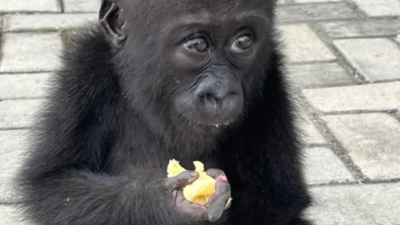
When Bili the baby gorilla was rescued from wildlife traffickers in Nigeria in 2023, she was sick, frightened, and so young that she needed constant reassurance from her human caregivers. For the next three years, she would sleep clinging to a rescuer, gradually recover from illness and learn to trust again. Now, after an international operation moved her to a forest sanctuary in the Republic of the Congo, the young western lowland gorilla is beginning another chapter, with conservationists hoping she may eventually return to the wild.According to CNN’s October 16 report, experts believe that some, if not all, of Bili’s family members were probably killed when she was taken from her natural habitat for the exotic pet trade. Her precise birthplace remains unknown, with Cameroon, Gabon and the Republic of the Congo among the possible origins. What is known is that she was intercepted in Lagos, Nigeria, in August 2023, when customs officials uncovered an attempted sale of the infant gorilla.Her rescue has since become a story of survival, international cooperation and the challenges of rehabilitating animals traumatised by wildlife trafficking.
Rescued from traffickers as an infant
Bili was only a few months old when Nigeria Customs Service officers seized her following an undercover operation conducted with Focused Conservation, a nonprofit organisation that works to disrupt wildlife trafficking networks. Investigators posed as potential buyers during the operation. Two men were subsequently arrested and convicted in connection with conspiracy, unlawful possession and the attempted sale of a gorilla, CNN reported.The infant was transferred to Drill Ranch, a primate rehabilitation centre in Calabar, Cross River State, operated by the Pandrillus Foundation. There, caregivers discovered that she was unwell and suffering from a fungal infection. Primatologist Lindsay Maess, who cared for Bili at the centre, described her survival as remarkable. Trafficked infant gorillas are particularly vulnerable because they lose the protection and nutrition provided by their mothers and must adapt to unfamiliar surroundings while recovering from illness and trauma.According to CNN, Maess estimated that more than 80% of trafficked gorillas do not survive. Bili’s distress was evident in her behaviour. She screamed when she saw a box or cage, while Pandrillus co-founder Peter Jenkins recalled that she clung to his body while sleeping during her first three months in care.“She was very young and needed that security — being loved,” Jenkins told CNN. Bili eventually shared an enclosure with Brendan and Mili, two chimpanzees who had also been rescued from traffickers. Their companionship helped her become more confident and emerge from her shell, Maess said.But recovery at a rescue centre was never intended to be the end of her journey. Bili needed a long-term home where she could continue developing the social and behavioural skills required for a life closer to the wild.
A journey across borders to a new home
On September 21, 2026, Bili began the journey from Calabar to Lagos by road. The trip took approximately 22 hours and was complicated by a vehicle breakdown and other delays. She then travelled on a DHL cargo flight from Lagos to Pointe-Noire, via Libreville, Gabon, arriving in the Republic of the Congo on September 23. From there, she was transported to the Tchimpounga Nature Reserve, a rehabilitation centre operated by the Jane Goodall Institute.The Jane Goodall Institute confirmed the transfer in a September 29 announcement, describing it as a collaborative operation involving conservation organisations, government agencies, customs authorities and transport partners. Bili travelled with Imelda Effiong, the caregiver who had looked after her for three years, and veterinarian Rebeca Atencia, executive director of the Jane Goodall Institute’s Republic of the Congo programme.The familiar faces were important during a journey that involved confinement, road travel, air transport and unfamiliar surroundings. At Tchimpounga, Bili has access to indoor and outdoor enclosures featuring forest and savannah environments. Atencia told CNN that the gorilla had adapted well to her new surroundings and demonstrated considerable resilience. The transfer marks a major milestone, but it does not mean Bili can immediately be released into the forest.
Can Bili return to the wild?
According to CNN, Bili was expected to undergo a 40-day quarantine and health checks before being introduced to Mozambique, a younger female gorilla already living at the sanctuary. The introduction is intended to help her develop social relationships and behaviours that are important for her long-term rehabilitation. If the process goes well, the two gorillas could eventually move to the Lesio-Louna Reserve, a protected area covering approximately 173,000 hectares in the Republic of the Congo. The reserve is managed by the country’s Ministry of Forest Economy and the Aspinall Foundation, which runs a gorilla rehabilitation and reintroduction programme.The ultimate goal is to give Bili an opportunity to progress towards living in the wild, although her future will depend on her health, behaviour and ability to adapt. “The hope is that, in time, this group will have the opportunity to progress through the rehabilitation and reintroduction process and ultimately return to a life in the wild,” Atencia told CNN.
The wider cost of wildlife trafficking
Bili’s journey also highlights the burden placed on rescue centres after trafficked animals are seized. While arrests and confiscations disrupt illegal trade, sanctuaries must fund years of specialised care, veterinary treatment and rehabilitation. CNN reported that Pandrillus cares for nearly 700 animals and that rescue centres in Nigeria are operating at capacity. Caring for an infant gorilla over several years can cost thousands of dollars in milk alone, apart from veterinary treatment, staff and facilities.Interpol estimates that wildlife crime generates approximately $20 billion annually, according to CNN’s report. The trade threatens endangered species while leaving rescued animals with physical and psychological damage that can take years to address.For Bili, the move to Congo offers something she lost when she was taken from the wild: the possibility of growing up in an environment where she can develop relationships with other gorillas and eventually live more independently.Her return to the forest is not guaranteed. But after three years of rehabilitation, an exhausting cross-border journey and a difficult start to life, Bili has been given another opportunity to thrive. As Atencia told CNN, the hope is that rescued gorillas such as Bili will receive “a second chance at a normal life.”