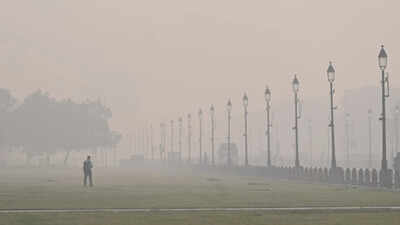
NEW DELHI: Delhi’s air quality remained in the severe category on Thursday morning, with the overall Air Quality Index (AQI) touching 482 at 8.01am. Several parts of the national capital continued to record high pollution levels.According to Central Pollution Control Board (CPCB) data, seven monitoring stations recorded AQI levels above 400, falling in the severe category.Punjabi Bagh recorded the highest AQI at 446, followed by Narela at 434, Rohini at 431, RK Puram at 416, Bawana at 412, North Campus, Delhi University, at 408 and Patparganj at 405.Several other areas reported very poor air quality. Okhla Phase-2 and India Gate both recorded an AQI of 399, followed by ITO at 397, Dwarka Sector 8 at 396, Chandni Chowk at 356 and Vasundhara Enclave at 330.Anand Vihar recorded an AQI of 293, while the IMD Lodhi Road station reported 268. Both stations fell in the poor category.Amid the deterioration in Delhi’s air quality, Union Environment Minister Bhupender Yadav said on Tuesday that the Centre’s air quality panel was continuously monitoring meteorological conditions, including wind direction, wind speed and the movement of air. He also assured that necessary action was being taken.The worsening air quality comes despite a decline in stubble-burning incidents compared to previous years. The government has claimed that a significant portion of paddy stubble has been utilised through ex-situ management.Asked about the reduction in stubble-burning incidents in neighbouring states, including Punjab, Haryana, Rajasthan and Uttar Pradesh, Yadav said, “Yes, I have already stated that around 40 per cent of the paddy stubble has been utilised through ex-situ management this time.”Responding to reporter’s question on why air quality continues to remain in the severe category despite these measures, Yadav said the Commission for Air Quality Management (CAQM) was closely monitoring meteorological conditions and taking necessary steps based on its assessments.“CAQM is continuously monitoring meteorological conditions, including wind direction, wind speed and the movement of air. Based on these assessments, the necessary steps are being taken,” he said.Dr Saurabh Mittal, Assistant Professor in the Department of Pulmonary, Critical Care and Sleep Medicine at AIIMS, Delhi, said, “Since AQI has increased, we are seeing patients who have prior respiratory problems, but now they are coming with increased symptoms and exacerbations, for which we need to increase their medications, like their inhaler doses have to be increased, and some patients need the addition of new medications such as oral steroids also to reduce their cough. We are also seeing patients who have previously been asymptomatic, but now, because of the increased pollution, they are developing respiratory symptoms in terms of cough, irritation of the throat, nasal irritation, and shortness of breath. So those patients also need some kind of treatment or decongestants for symptom relief… There has been an increase in people actually calling us… I would say that we anticipate that this number is probably going to increase in the next couple of weeks…”Explaining the factors contributing to the pollution, Mittal said, “It’s a multifactorial problem. It’s not a one-time or one-day problem. Of course, weather contributes significantly to it; as the winter weather appears, the condensation happens. Of course, vehicular emissions, construction, stubble burning – all of these things contribute to a larger extent. But individual contribution is very difficult to kind of quantify. But yes, if we reduce all of them, it’s likely that we’ll have some relief from the problem.”(With Agency Inputs)